
Introduction
Marriage is one of the oldest and most significant social institutions in human civilization. It is not merely a legal contract between two individuals but also a social, cultural, emotional, and spiritual bond. Marriage in India holds immense importance because it connects not only two individuals but often two families and communities.
Over centuries, the concept of marriage in India has evolved significantly. Ancient customs, religious beliefs, societal values, and legal reforms have all played a role in shaping the institution of marriage as it exists today. Modern laws seek to balance traditional values with constitutional principles such as equality, dignity, and individual rights.
This article explores the meaning of marriage, its importance in Hindu culture, different types of marriages recognized in India, concepts such as bigamy and polygamy, and the significance of the Hindu Marriage Act, 1955.
What is Marriage?
Marriage is a socially and legally recognized union between two individuals that establishes rights and responsibilities between spouses, their families, and any children born from the union.
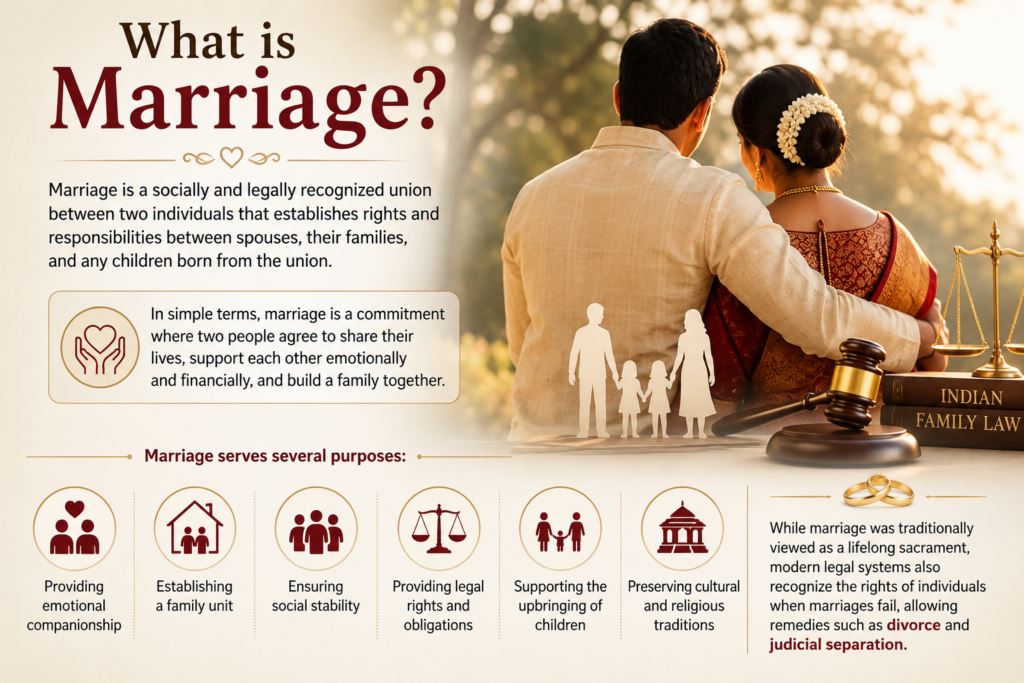
In simple terms, marriage is a commitment where two people agree to share their lives, support each other emotionally and financially, and build a family together.
Marriage serves several purposes:
- Providing emotional companionship
- Establishing a family unit
- Ensuring social stability
- Providing legal rights and obligations
- Supporting the upbringing of children
- Preserving cultural and religious traditions
While marriage was traditionally viewed as a lifelong sacrament, modern legal systems also recognize the rights of individuals when marriages fail, allowing remedies such as divorce and judicial separation.
Marriage in Hindu Culture
In Hindu tradition, marriage is considered one of the most sacred ceremonies in a person’s life. It is viewed as a “Sanskara,” meaning a sacred rite or sacrament.
Unlike some traditions where marriage is seen primarily as a contract, Hindu philosophy treats marriage as a spiritual union intended to continue beyond a single lifetime.
According to Hindu scriptures, marriage enables individuals to fulfill important duties, including:
Dharma (Duty): Marriage helps individuals perform religious and social responsibilities.
Artha (Prosperity): Spouses support each other in achieving economic stability and prosperity.
Kama (Desires): Marriage provides a socially accepted framework for emotional and physical companionship.
Moksha (Spiritual Liberation)
Through mutual support and righteous living, spouses help each other progress spiritually.
The sacred ritual of “Saptapadi” (Seven Steps) is considered one of the most important parts of a Hindu marriage ceremony. During these seven steps, the couple makes promises regarding mutual respect, support, prosperity, family welfare, and lifelong companionship.
Historical Evolution of Marriage in India
Marriage in India have undergone significant changes over time.
Ancient Period: Ancient Hindu texts described various forms of marriage. Family and social structures were deeply connected to religious customs. Marriages were generally arranged by families and community elders.
Medieval Period: Social customs became more rigid. Child marriage, restrictions on widow remarriage, and unequal treatment of women became more common in several regions.
Colonial Period: During the colonial era, several social reform movements emerged to address harmful social practices and improve the status of women in Indian society. Reformers and intellectuals recognized the need for legal and social changes to promote equality, education, and dignity for women.
Notable reformers such as Raja Ram Mohan Roy and Ishwar Chandra Vidyasagar played a significant role in advocating for women’s rights. Their efforts contributed to important reforms, including the promotion of widow remarriage, expansion of women’s education, and the abolition of discriminatory social practices.
These reform movements laid the foundation for many of the legal changes that later influenced modern marriage laws and women’s rights in India.
Post-Independence Era: After India gained independence, lawmakers introduced comprehensive legislation to modernize family laws and ensure greater equality. One of the most important reforms was the Hindu Marriage Act, 1955 of Marriage in India.
Types of Marriage in Hindu Tradition
Ancient Hindu scriptures describe eight forms of marriage. Some were highly respected, while others were discouraged.
1. Brahma Marriage: This was considered the most respected form of marriage.
The bride’s father voluntarily gave his daughter to a worthy and educated groom without expecting any payment.
2. Daiva Marriage: The daughter was given in marriage to a priest who performed religious ceremonies for the family.
3. Arsha Marriage: The groom presented symbolic gifts, usually cows, to the bride’s family.
4. Prajapatya Marriage: Marriage was performed with blessings emphasizing mutual duties and responsibilities.
5. Gandharva Marriage: This resembles modern love marriage.
The man and woman married based on mutual affection and consent.
6. Asura Marriage: The groom effectively purchased the bride by offering wealth to her family.
This practice was not considered ideal.
7. Rakshasa Marriage: Marriage by force or abduction.
Historically associated with warrior communities.
8. Paisacha Marriage: The most condemned form.
It involved exploitation without valid consent and was considered immoral.
Among these, Brahma, Daiva, Arsha, and Prajapatya marriages were generally regarded as the most respectable.
Types of Marriage in Modern India
Modern Indian law recognizes several forms of marriage.
Arranged Marriage: Families play a major role in selecting a suitable partner.
This remains one of the most common forms of Marriage in India.
Love Marriage: Individuals choose their own partners based on mutual affection and consent.
Inter-Caste Marriage : Partners belong to different castes.
Such Marriage in India are legally valid and encouraged as a step toward social equality.
Inter-Caste Marriage: Individuals from different religions may marry under the Special Marriage Act, 1954.
Civil Marriage: Marriage conducted before a marriage registrar under legal provisions without religious ceremonies.
Monogamy refers to marriage between one man and one woman at a time.
Under the Hindu Marriage Act 1955, monogamy is mandatory for Hindus.
A person cannot legally marry another individual while the first spouse is alive and the marriage remains valid.
Monogamy promotes:
- Equality between spouses
- Family stability
- Legal certainty
- Protection of rights
Bigamy occurs when a person marries another individual while already legally married to someone else.
In simple words, a second marriage during the lifetime of a legally wedded spouse is called bigamy.
Example: If a married man enters into another marriage without obtaining a legal divorce from his first wife, the second marriage may amount to bigamy.
Under Indian law, bigamy is generally prohibited for Hindus, Christians, Parsis, and individuals married under civil marriage laws.
Punishment for Bigamy in India
Bigamy is punishable under the provisions of the Indian criminal law.
A person found guilty may face :
- Imprisonment
- Fine
- Both imprisonment and fine
The second marriage is generally considered void if the first marriage remains legally valid at Marriage in India.
The law aims to protect spouses from deception and unfair treatment.
What is Polygamy?
Polygamy refers to the practice of having more than one spouse at the same time.
It is broadly classified into two categories.
Polygyny: One man having multiple wives.
Polyandry : One woman having multiple husbands.
Historically, polygamy existed in various societies across the world for social, economic, and political reasons at Marriage in India.
Today, most modern legal systems favor monogamy because it promotes equality and protects individual rights at Marriage in India.
Difference Between Bigamy and Polygamy.
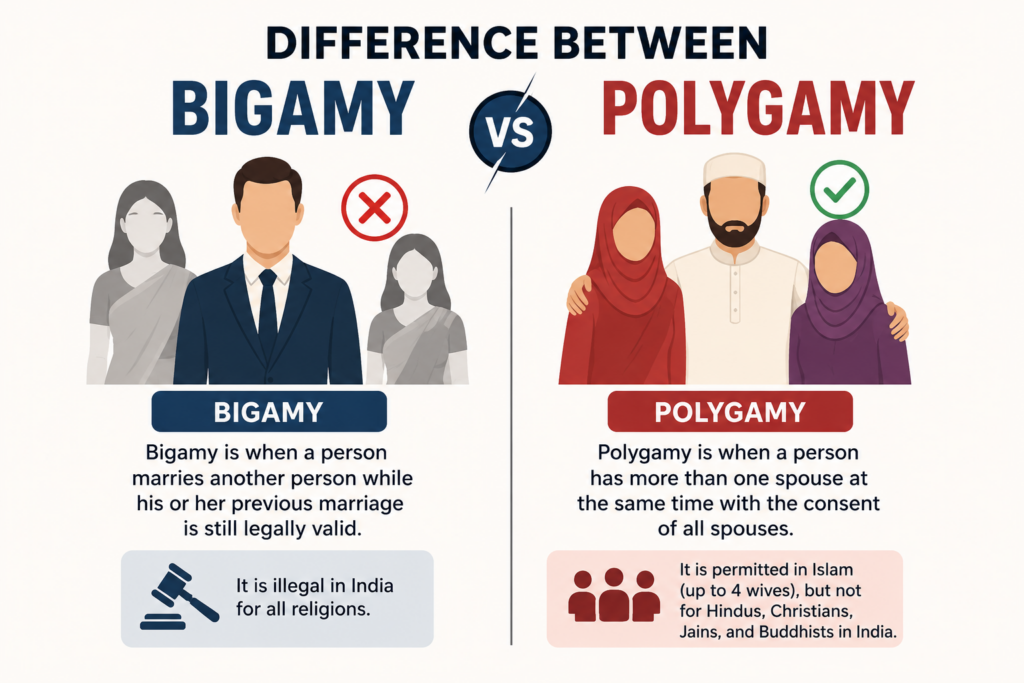
| Basis | Bigamy | Polygamy |
| Meaning | Marrying another person while already married | Having multiple spouses simultaneously |
| Nature | Usually refers to a specific second marriage | Refers to a broader marital system |
| Legal Status | Generally illegal under Hindu law | Generally not permitted under Hindu law |
| Scope | One additional marriage | Multiple spouses |
Why Was the Hindu Marriage Act, 1955 Introduced?
Before independence, Hindu marriages were primarily governed by customs, traditions, and regional practices.
These customs often varied from one community to another, creating inconsistency and legal uncertainty in Marriage in India.
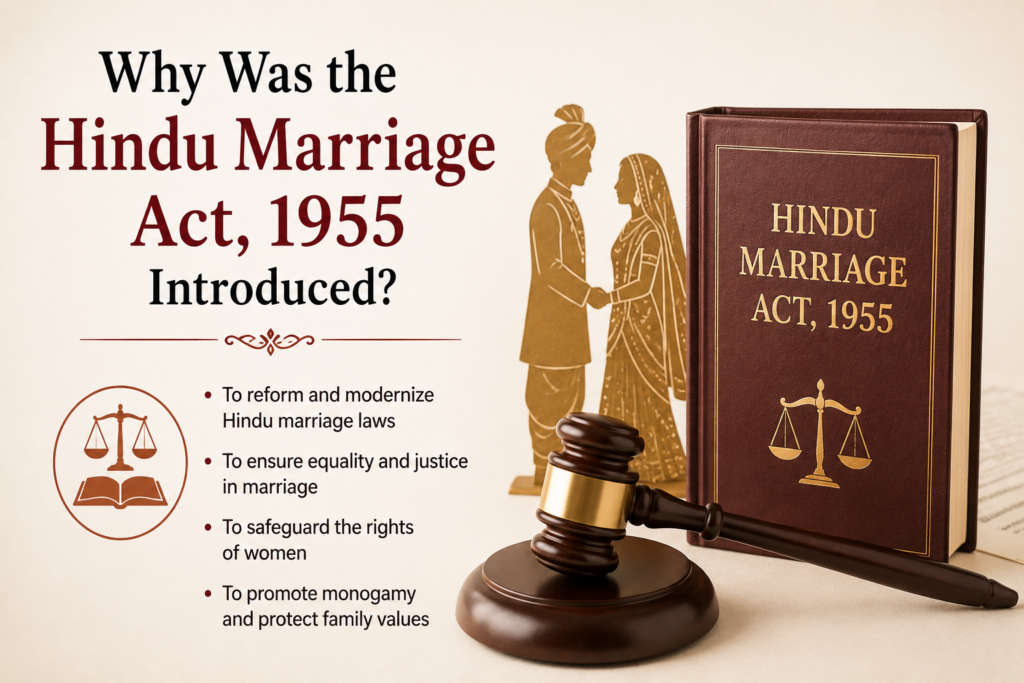
The Hindu Marriage Act, 1955 was enacted to modernize Hindu personal law and establish uniform legal standards in Marriage in India.
The objectives included:
1. Establishing Monogam: The Act prohibited multiple marriages among Hindus.
2. Protecting Women’s Rights: Women gained stronger legal protections regarding marriage and divorce.
3. Providing Legal Recognition: The Act established clear conditions for valid marriages.
4. Introducing Divorce Provisions: For the first time, Hindus received statutory grounds for divorce.
The legislation aimed to remove outdated and discriminatory practices.
5. Promoting Social Reform: The legislation aimed to remove outdated and discriminatory practices.
Key Features of the Hindu Marriage Act, 1955
Conditions for a Valid Marriage in India
The parties must:
- Be legally eligible to marry
- Not have a living spouse
- Be capable of giving valid consent
- Meet the prescribed age requirements
- Not fall within prohibited relationships unless permitted by custom
Restitution of Conjugal Rights: A spouse may seek legal remedy if the other spouse withdraws from the marriage without reasonable cause.
Judicial Separation: Spouses may live separately without dissolving the marriage.
Divorce: The Act provides various grounds for divorce.
Maintenance: Financial support may be awarded to a spouse when legally justified.
Marriage in India & Grounds for Divorce Under Hindu Law
Some common grounds include:
- Cruelty
- Adultery
- Desertion
- Conversion to another religion
- Mental disorder under specified conditions
- Communicable diseases under legal provisions
- Renunciation of the world
- Presumption of death
Mutual consent divorce is also available when both spouses agree to dissolve the Marriage in India.
Marriage and Constitutional Values
Modern Indian marriage laws increasingly reflect constitutional principles such as:
- Equality
- Individual liberty
- Human dignity
- Non-discrimination
- Freedom of choice
Courts have repeatedly emphasized that adults have the right to choose their life partners regardless of caste, religion, or social background, subject to legal requirements at Marriage in India.
Challenges in Modern Marriage in India
Despite legal reforms, several challenges continue to exist:
- Domestic violence
- Dowry-related issues
- Marital disputes
- Social pressure
- Family interference
- Financial conflicts
- Compatibility concerns
Legal awareness and mutual respect remain essential for healthy marital relationships.
Conclusion : Marriage is one of the most important social institutions in India. Marriage in India combines emotional, social, cultural, religious, and legal dimensions. In Hindu culture, marriage has traditionally been regarded as a sacred bond and a lifelong commitment. Over time, society has moved toward a more rights-based understanding of marriage that emphasizes equality, consent, and dignity.
The Hindu Marriage Act, 1955 played a transformative role in modernizing Hindu personal law by introducing monogamy, protecting women’s rights, providing divorce remedies, and ensuring greater legal certainty. Concepts such as bigamy and polygamy continue to be important legal topics because they directly affect family rights and social justice.
Understanding marriage and the laws governing it helps individuals make informed decisions and appreciate both the cultural significance and legal responsibilities associated with this important institution.
Frequently Asked Questions (FAQs)
1. What is the legal meaning of Marriage in India ?
Marriage is a legally recognized union between two individuals that creates rights and responsibilities between spouses and their families.
2. What is the difference between bigamy and polygamy?
Bigamy refers to marrying another person while already legally married, whereas polygamy refers to having multiple spouses simultaneously.
3. Is bigamy legal under Hindu law?
No. Bigamy is prohibited under the Hindu Marriage Act, 1955, and may attract legal consequences of Marriage in India.
4. What is the main purpose of the Hindu Marriage Act, 1955?
The Act was introduced to modernize Hindu marriage laws, establish monogamy, protect rights, and provide legal remedies such as divorce and maintenance.
5. What are the main types of marriage in modern India?
Common forms of Marriage in India include arranged marriages, love marriages, inter-caste marriages, inter-religious marriages, and civil marriages.
6. Why is consent important in marriage?
Consent ensures that both individuals voluntarily agree to enter the marital relationship, making the marriage legally and ethically valid.