
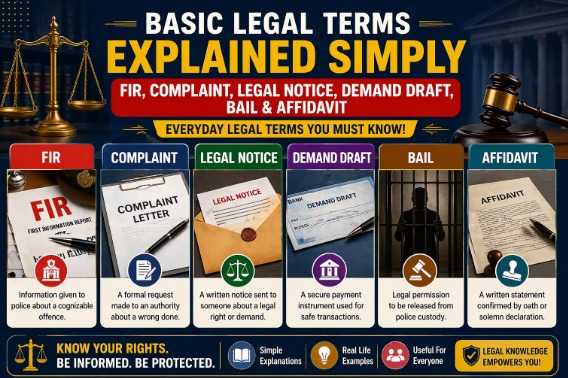
Introduction : Understanding Basic legal terms in India can feel confusing, especially if you are not from a legal background. Words like FIR, complaint, notice, or demand draft are commonly used, but many people don’t clearly know what they mean or when to use them. This article is designed to explain these important legal concepts in simple and practical language, so anyone can understand them easily. Whether you are a student, working professional, or just curious, this guide will help you understand the basics of law in everyday life.
⚖️ What is an FIR (First Information Report)? Understanding Basic legal terms in India
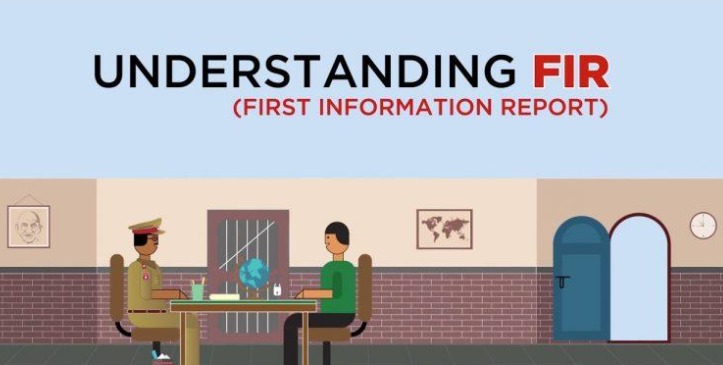
An FIR (First Information Report) is a written document prepared by the police when they receive information about the commission of a cognizable offense (serious crime).
📌 Key Points:
- It is registered under Section 154 of the Criminal Procedure Code (CrPC)
- Police must register FIR if the offense is serious (like theft, murder, assault)
- It starts the criminal investigation process
📍 Examples of FIR (for illustration purposes only):
- Amit was physically assaulted during a dispute in his neighborhood. He reported the incident at the police station by filing an FIR, after which the police initiated legal action against the accused.
- Priya received repeated threatening calls from an unknown person. Feeling unsafe, she approached the police and filed an FIR. The police began tracing the caller’s details.
- Ravi noticed that his bike was stolen from outside his office. He went to the police station and filed an FIR. The police registered the complaint and started searching for the vehicle.
- Neha found that someone had hacked her bank account and transferred money without permission. She filed an FIR at the nearest police station, and the cybercrime team started investigating the fraud.
🧾 What is a Complaint? Understanding Basic legal terms in India
A complaint is a statement made by a person to a magistrate or police regarding an offense. It may or may not lead to an FIR.
📌 Key Points:
- It can be written or oral
- Used in both civil and criminal matters
- Not all complaints become FIRs
📍Examples of Complaint (For illustration purposes only)
- Ramesh was facing constant noise disturbance from his neighbor late at night. He submitted a complaint to the local police station requesting action to maintain peace.
- Anita noticed that a shopkeeper was overcharging customers unfairly. She filed a complaint with the consumer forum seeking proper action against the shop owner.
- Suresh had a disagreement with his business partner regarding payment issues. He approached the magistrate and filed a complaint to resolve the dispute legally.
💰 What is a Demand Draft (DD)?
A Demand Draft is a prepaid financial instrument issued by a bank, guaranteeing payment to the specified person.
📌 Key Points:
- Safer than cash
- Commonly used for official payments
- Cannot bounce like a Cheque
📍 Examples of Demand Draft (For illustration purposes only) :
- Rahul applied for a university admission and was asked to pay the application fee through a demand draft. He visited the bank, got a DD issued, and submitted it along with his application form.
- Sneha needed to pay registration fees for a government job exam. Since online payment was not available, she purchased a demand draft from her bank and sent it to the exam authority.
- Vikram was buying a property and the seller requested a secure payment method. To ensure safety, Vikram made part of the payment using a demand draft issued by his bank.
📩 What is a Legal Notice?
A legal notice is a formal written communication sent by one person to another, informing them of a legal issue or grievance.
📌 Key Points:
- Sent before filing a case
- Gives the other party a chance to respond
- Helps avoid court in some cases
📍Examples of Legal Notice (For illustration purposes only):
- Arjun rented his apartment to a tenant named Rakesh. Even after the agreement ended, Rakesh refused to vacate the property. Arjun sent a legal notice asking him to vacate within a specified time before taking legal action.
- Pooja purchased a product online, but it turned out to be defective and the seller refused to replace it. She sent a legal notice to the company demanding a refund or replacement.
- Kiran lent money to his friend Manoj, who failed to repay even after multiple reminders. Kiran sent a legal notice demanding repayment within 15 days, warning of further legal action if ignored.
📜 What is an Affidavit?
An affidavit is a written statement confirmed by oath or affirmation, used as evidence in court.
📌 Key Points:
- Must be signed in presence of an authorized officer
- Used in legal and administrative processes
📍Examples of an Affidavit (For illustration purposes only):
- Suman lost her original documents and needed duplicates. She submitted an affidavit declaring the loss and requesting reissue of her certificates.
- Ravi changed his name officially and submitted an affidavit confirming his old and new names for legal records.
- Anjali applied for a passport and provided an affidavit as proof of her residential address.
🧑⚖️ What is Bail?
Bail is the temporary release of a person accused of a crime, on the condition that they will appear in court when required.
📌 Key Points:
- Granted by court
- Can be with or without conditions
📍Examples of Bail (For illustration purposes only)
- Karthik was arrested for a minor traffic violation. He was granted bail by the court and released on the condition that he would appear on the hearing date.
- Meena was accused in a small financial dispute. She applied for bail and was released after providing surety.
- Rohit was arrested during a protest but was later granted bail by the court with instructions to cooperate in the investigation.
📄 What is an Agreement?
An agreement is a mutual understanding between two or more parties regarding their rights and responsibilities.
📌 Key Points:
- Can be written or oral
- Becomes legally binding if enforceable by law
📍Examples of an Agreement (For illustration purposes only):
- Amit and his friend Raj agreed to start a small business together and created a written agreement outlining their roles and profit sharing.
- Priya hired a tutor for her child and made an agreement regarding monthly fees and teaching schedule.
- Vikas agreed to sell his car to Sandeep, and both parties signed an agreement mentioning price and transfer details.
👉 To understand agreements in detail, including their types and legal importance, read our complete guide here: https://www.hyphub.com/what-is-agreement-and-types/
📑 What is a Contract?
A contract is a legally enforceable agreement between parties.
📌 Key Points:
- Must include offer, acceptance, and consideration
- Legally binding
📍Examples of Contract (For illustration purposes only):
- Neha signed an employment contract with a company that specified her salary, job role, and working hours.
- A construction company entered into a contract with a client to build a house within a fixed time and budget.
- Ramesh signed a service contract with an internet provider for a one-year subscription plan.
🧾 What is a Cheque?
A cheque is a written order directing a bank to pay a specific amount from one person’s account to another.
📌 Key Points:
- Can bounce if insufficient funds
- Used for payments
📍Examples of a Cheque (For illustration purposes only):
- Suresh paid his monthly house rent by issuing a cheque to his landlord.
- Lakshmi issued a cheque to pay her child’s school fees instead of using cash.
- Arun gave a cheque to his supplier as payment for goods purchased for his shop.
⚠️ Difference Between FIR, Complaint & Legal Notice
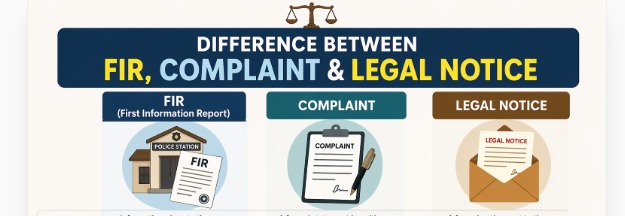
| Feature | FIR | Complaint | Legal Notice |
| Purpose | To report a serious (cognizable) crime | To report a grievance or issue | To formally warn before legal action |
| Nature of Issue | Criminal (serious offenses like theft, murder) | Civil or minor criminal issues | Mostly civil disputes (property, money, etc.) |
| Filed Before | Police | Police or Magistrate | Sent by one party to another |
| Legal Provision | Section 154 of CrPC | Defined under CrPC (varies by case) | No strict format, but recognized in legal practice |
| Investigation | Starts immediately after FIR | May or may not lead to investigation | No investigation, gives chance to respond |
| Mandatory Action | Police must register for cognizable offense | Depends on situation | Receiver may reply or ignore |
| Main Objective | Start criminal proceedings | Seek action or resolution | Avoid court by giving warning |
| Example | Reporting theft or assault | Noise complaint against neighbor | Notice to tenant to vacate house |
📌Why Understanding These Basic legal terms in India is Important
Knowing basic legal terms helps you:
- Protect your rights
- Avoid fraud
- Take correct legal action
- Feel confident in legal situations
✅ Conclusion
Legal knowledge is not just for lawyers – Basic legal terms in India are important for every citizen. Understanding terms like FIR, complaint, demand draft, and legal notice can help you make informed decisions and handle real-life situations better.
This article aimed to simplify these concepts so that anyone can understand them without confusion. The more aware you are, the more empowered you become.
❓ FAQs
1. Can FIR be filed online?
Yes, in many states in India, online FIR filing is available for certain cases.
2. Is a legal notice mandatory before filing a case?
Not always, but it is recommended in many civil matters.
3. Can a complaint be rejected?
Yes, if there is no valid reason or evidence.
4. Is a demand draft refundable?
It depends on bank policies and conditions.