
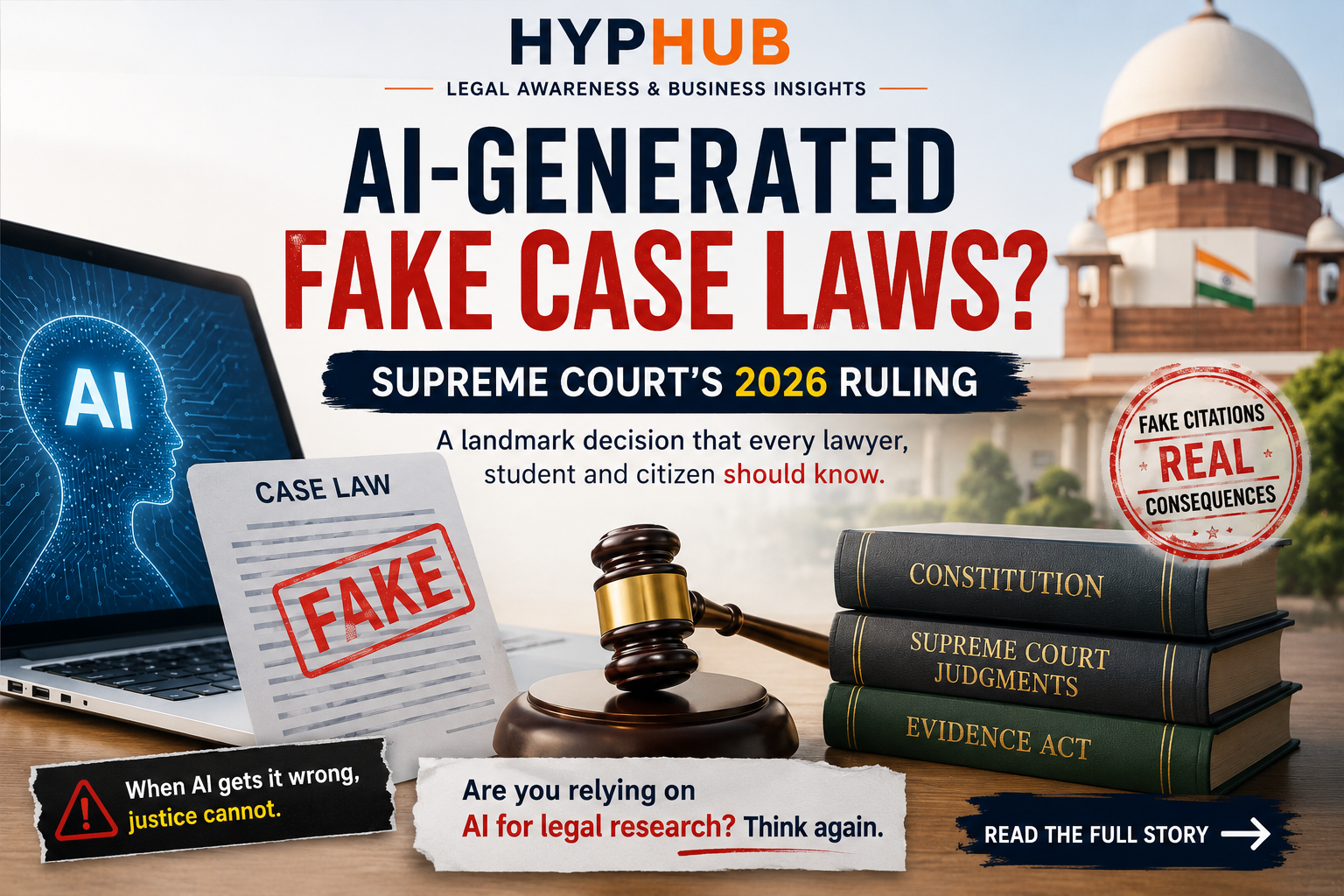
Artificial Intelligence is rapidly changing the way people work, communicate and access information. The legal profession is no exception. Lawyers, law students, judges and legal researchers are increasingly using AI tools to search for information, summarize documents, prepare drafts and understand complicated legal concepts & AI-generated fake case laws.
But what happens when Artificial Intelligence creates a court judgment or legal precedent that does not actually exist?
This question has moved from theory to reality in India.
In a significant judgment delivered on 2 July 2026, the Supreme Court of India dealt with a case involving fake and AI-generated legal citations. The Court set aside decisions of the National Company Law Tribunal (NCLT) and the National Company Law Appellate Tribunal (NCLAT) after finding that non-existent judgments and fabricated paragraphs had been relied upon as legal precedents.
The Supreme Court made it clear that AI can be used as a technological aid, but human beings must remain responsible for verifying legal authorities before relying on them. The Court also adopted a zero-tolerance approach toward citing AI-generated or hallucinated precedents without verification.
This judgment could become an important milestone in the relationship between Artificial Intelligence and Indian law.
AI-Generated Fake Case Laws: What Is AI Hallucination in Law?
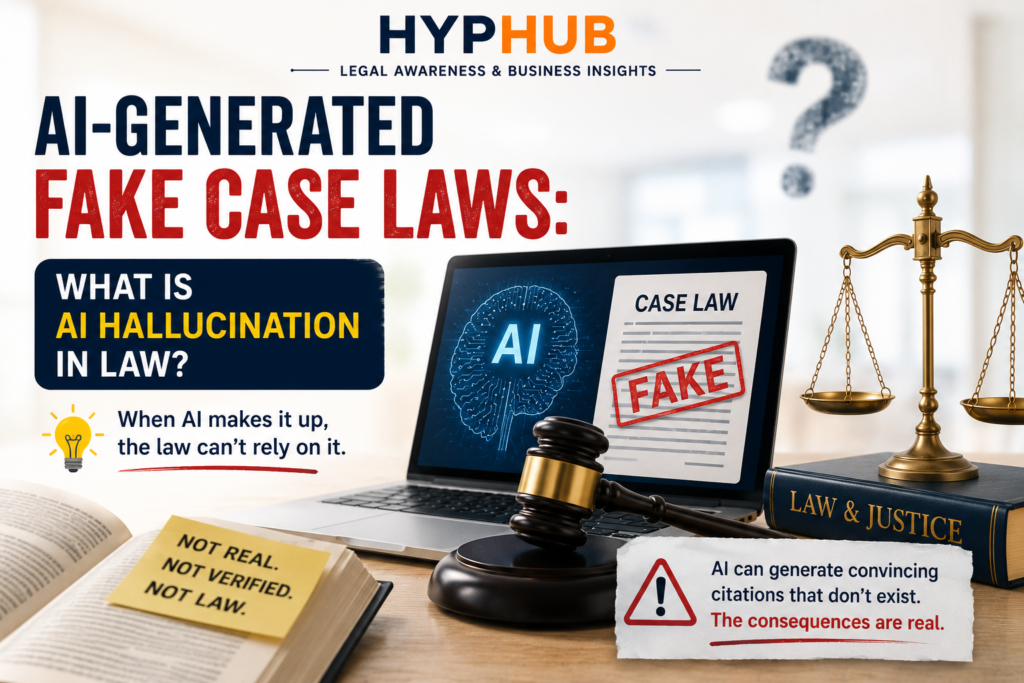
AI hallucination refers to a situation where an Artificial Intelligence system produces information that appears convincing but is actually incorrect, fabricated or unsupported by reality.
In ordinary conversation, an incorrect AI answer may simply cause confusion.
In law, however, the consequences can be much more serious.
A lawyer may ask an AI tool to find judgments supporting a particular legal argument. The AI may respond with:
- A case name that does not exist
- An incorrect case citation
- A genuine case with an incorrect paragraph
- A judgment attributed to the wrong court
- A legal principle that was never actually stated by a court
Because the response may be written in professional legal language, it can appear genuine to someone who does not independently verify it.
This is particularly dangerous because legal precedents are not merely informational material. Courts and lawyers rely on authentic judicial decisions to understand how legal principles have been interpreted and applied.
AI-Generated Fake Case Laws: What Happened in the Supreme Court Case?
The case was Pooja Ramesh Singh v. Jammu and Kashmir Bank Ltd. & Anr., decided on 2 July 2026 and reported as 2026 INSC 668.
The dispute arose in connection with insolvency proceedings involving Essel Infraprojects Ltd. Jammu and Kashmir Bank had initiated proceedings under Section 7 of the Insolvency and Bankruptcy Code, 2016.
The NCLT admitted the insolvency application. The matter subsequently reached the NCLAT.
During the proceedings, several judicial decisions were cited in support of the tribunal’s reasoning. However, serious questions were later raised regarding the authenticity of those citations.
The Supreme Court examined the material and found that the problem was not merely an ordinary citation mistake.
According to the Supreme Court’s official judgment summary, six citations were relied upon. Some were completely non-existent, while other citations referred to genuine judgments but attributed paragraphs to them that could not be found in the actual decisions.
The Supreme Court therefore set aside the NCLT and NCLAT decisions and sent the matter back to the NCLT for fresh consideration on its merits.
Why Are AI-Generated Fake Case Laws So Important in This Judgment?
The judgment is important because it addresses a problem that is likely to become more common as AI tools become increasingly integrated into professional work.
The Supreme Court recognized that AI can substantially assist human beings with intellectual and routine tasks. At the same time, it emphasized that AI is different from ordinary technological tools because it can appear to perform human-like reasoning and produce convincing answers.
That creates a serious risk when the output is accepted without verification.
The Court emphasized that judicial decision-making must remain under human control and that AI cannot replace the responsibility of judges, lawyers or other legal professionals.
In simple words:
AI can assist legal professionals, but AI cannot become the authority for deciding what the law actually is.
Supreme Court’s Zero-Tolerance Approach
One of the most important aspects of the judgment is the Court’s strong warning against unverified AI-generated precedents.
The Supreme Court stated that courts must adopt a zero-tolerance approach toward producing, citing or relying upon AI-generated precedents without verification.
The Court further observed that an advocate citing such material without verification can amount to misconduct. It also described reliance by a judge on fake or hallucinated AI-generated material as a serious lapse.
This creates an important professional responsibility for lawyers.
If an AI tool provides a citation, the lawyer cannot simply assume that it is correct because the citation looks authentic.
The lawyer must independently check the:
- Case name
- Court
- Case number
- Date of judgment
- Citation
- Relevant paragraph
- Legal proposition
- Whether the judgment is still good law
Only after verification should the authority be relied upon.
Can Lawyers Still Use AI?
Yes.
The Supreme Court judgment does not mean that lawyers are prohibited from using Artificial Intelligence.
Instead, it draws a distinction between using AI as an assistance tool and treating AI-generated information as verified legal authority.
For example, a lawyer may use AI to:
- Summarize a lengthy judgment
- Identify possible legal issues
- Generate research keywords
- Organize arguments
- Prepare a preliminary draft
- Explain a complicated legal concept
- Compare provisions of different laws
However, the final legal research must be independently verified using authentic legal sources.
This principle is particularly important for young lawyers and law students who may rely heavily on AI because it saves time.
AI can help you find the door.
It cannot guarantee that the room behind the door actually exists.
What Does This Mean for Law Students?
The judgment also has an important lesson for law students.
AI tools can make studying law much easier. Students can ask questions in simple language, request explanations of legal provisions and even practice hypothetical problems.
But students should develop one habit early:
Always verify important legal information from the original source.
For example, if an AI tool says: “The Supreme Court held that…”
A law student should not immediately include that statement in an assignment or examination answer.
Instead, the student should locate the actual judgment and confirm what the Court really held.
This habit will become increasingly important as AI-generated legal content becomes widespread on websites, social media platforms and educational forums.
What Does This Mean for Judges and Courts?
The issue is even more serious for courts.
A judicial decision affects the rights and obligations of real people and organizations. Therefore, the legal authorities supporting a judgment must be authentic.
The Supreme Court’s judgment emphasizes the need for human control over AI-assisted adjudication.
The Court’s official materials also show that the judiciary has been considering broader frameworks for responsible AI use in courts. The Supreme Court had invited comments on draft Regulations for the Use of Artificial Intelligence in Courts, 2026.
This indicates that the Indian judiciary is not rejecting technology.
Instead, the emerging approach appears to be:
Technology should assist justice, not control justice.
AI and the Future of Legal Research
Traditional legal research can be time-consuming.
A lawyer may have to search through hundreds of judgments to identify a particular legal principle. AI can potentially make this process faster by helping organize large volumes of information.
However, speed comes with a new responsibility.
Earlier, the major problem in legal research was finding the correct judgment.
With generative AI, another problem has emerged:
Determining whether the judgment suggested by the machine actually exists.
This changes the role of the lawyer.
Future legal professionals may need two skills simultaneously:
1. Traditional Legal Research
Lawyers must understand statutes, precedents, rules, regulations and constitutional principles.
2. AI Verification
They must also understand how AI systems generate information and how to detect and verify potentially fabricated outputs.
The lawyer of the future may therefore need to be both a legal researcher and a technology-aware professional.
Can AI Replace Lawyers?
This judgment provides an important answer to that question.
AI may automate several repetitive legal tasks, but legal practice involves much more than generating text.
Lawyers must understand facts, assess evidence, interpret legal provisions, exercise professional judgment, communicate with clients and make strategic decisions.
Most importantly, someone must take responsibility for the advice or argument presented before a court.
AI does not appear in court and accept professional responsibility in the way a lawyer does.
Therefore, the more realistic future is not necessarily AI replacing lawyers.
It is more likely to be:
Lawyers using AI replacing lawyers who refuse to understand AI.
At the same time, lawyers who blindly trust AI may create serious professional and legal risks.
What Should Lawyers Do Before Using an AI-Generated Judgment?
A simple verification checklist can reduce the risk of relying on fabricated material.
Before citing an AI-generated case, a lawyer should:
Step 1: Search the case independently.
Use an authentic legal database or official court source.
Step 2: Verify the citation.
Check whether the citation corresponds to the correct judgment.
Step 3: Read the original judgment.
Do not rely only on an AI-generated summary.
Step 4: Check the paragraph.
If AI identifies a particular paragraph, compare it with the actual judgment.
Step 5: Check the legal position.
A judgment may have been overruled, distinguished or affected by subsequent decisions.
Step 6: Verify before filing.
Every authority included in a court filing should be checked before submission.
This process may take additional time, but it can prevent a much more serious mistake.
A Warning for the General Public
The problem is not limited to lawyers.
Millions of people now use AI tools to ask questions such as:
- “Can my employer legally fire me?”
- “Can I get bail?”
- “Can I claim property from my parents?”
- “What happens if someone sends me a legal notice?”
- “Can I file a case against my landlord?”
AI can provide general information, but people should be careful about treating an AI response as personalized legal advice.
A legal dispute depends on facts, documents, applicable laws and judicial interpretation.
A confident AI answer does not automatically mean it is a legally correct answer.
The Bigger Legal Question: Who Is Responsible for an AI Mistake?
The development of AI raises an important question for the legal system.
Suppose an AI system generates a completely false judgment and a lawyer unknowingly relies on it.
Who should be responsible?
The lawyer?
The AI company?
The person who supplied the prompt?
Or should responsibility depend on whether the professional independently verified the information?
There is no simple answer.
However, the Supreme Court’s 2026 judgment strongly reinforces one principle: legal professionals cannot transfer their responsibility for verification to an AI system.
The use of technology does not eliminate professional responsibility.
What Could Happen Next?
The Supreme Court directed the Bar Council of India to constitute a committee to consider the issue of advocates submitting fake or hallucinated material as precedent and to prescribe guiding principles and disciplinary consequences.
This could eventually contribute to clearer professional standards regarding the use of generative AI in legal practice.
The legal profession may also see greater emphasis on:
- AI-use policies for law firms
- Verification protocols
- Confidentiality safeguards
- Data protection
- Responsible legal research
- Training for lawyers and judges
- Disclosure or documentation of AI-assisted work where required
As AI becomes more powerful, the legal profession will need rules that balance innovation with accountability.
Final Thoughts
The Supreme Court’s 2026 judgment sends a powerful message at a time when Artificial Intelligence is becoming part of almost every profession.
The Court has not rejected AI.
Instead, it has drawn a boundary.
AI may assist human reasoning, but it cannot replace human responsibility in the justice system.
A fabricated social-media post may be corrected with another post. A wrong AI-generated legal citation can be much more dangerous when it enters a court proceeding.
For lawyers, judges and law students, the lesson is straightforward:
Never cite a case merely because AI provided the citation. Verify it. Read it. Understand it. Then rely on it.
The future of legal technology will not be determined simply by how powerful AI becomes. It will also depend on how responsibly legal professionals use it.
Technology can make justice faster.
But only careful human judgment can help ensure that it remains accurate, fair and lawful.
Frequently Asked Questions
1. What is an AI hallucination in legal research?
An AI hallucination occurs when an AI system generates information that appears genuine but is actually false, such as a non-existent judgment, incorrect citation or fabricated paragraph.
2. What did the Supreme Court decide in Pooja Ramesh Singh v. Jammu and Kashmir Bank?
The Supreme Court set aside the NCLT and NCLAT decisions after finding that fake and AI-hallucinated legal material had been relied upon. The matter was remitted to the NCLT for fresh consideration.
3. Can lawyers use Artificial Intelligence for legal research?
Yes. The judgment does not prohibit legitimate AI assistance. However, AI-generated legal authorities must be independently verified before they are relied upon.
4. Is citing an AI-generated fake judgment serious misconduct?
The Supreme Court stated that an advocate citing AI-generated judgments without verification can amount to misconduct and adopted a zero-tolerance approach toward such material.
5. Can AI replace lawyers?
AI can assist with many legal tasks, but legal practice involves professional judgment, responsibility, strategy and interpretation. The growing role of AI is therefore more likely to transform legal work than simply eliminate lawyers.
6. Why is this judgment important for law students?
It teaches an important legal-research principle: never blindly rely on a secondary or AI-generated source. Students should verify important case law using authentic judgments and reliable legal databases.
Legal Disclaimer
This article is intended for general legal awareness and educational purposes only. It does not constitute legal advice or create a lawyer-client relationship. Laws, judgments, and regulatory requirements may change over time. Readers should consult a qualified legal professional for advice relating to their specific circumstances.
Hyphub – Legal Awareness & Business Insights