
Introduction: Imagine living in a country where there were no courts to resolve disputes, protect people’s rights, or punish those who break the law. Conflicts could easily turn into violence, and justice would depend on power rather than fairness. Fortunately, India has one of the world’s largest and most respected judicial systems, built to ensure that every citizen receives justice under the rule of law.
The Indian judicial system is one of the three pillars of Indian democracy, alongside the Legislature and the Executive. While the legislature makes laws and the Executive implements them, the Judiciary interprets laws, protects the Constitution, safeguards citizens’ rights, and ensures that justice is delivered without discrimination.
Whether it is a family dispute, a property disagreement, a criminal offence, or a constitutional challenge affecting millions of people, the judiciary provides a legal mechanism to resolve disputes peacefully and fairly. Indian Judicial System ensures that no individual or authority is above the law.
India follows a single integrated judicial system, meaning that all courts are interconnected in a well-defined hierarchy. The Supreme Court stands at the highest level, followed by High Courts, District Courts, and several specialized courts and tribunals that deal with different types of legal matters.
In this comprehensive guide, you will learn how the Indian Judicial System works, the hierarchy of courts, the powers and jurisdiction of different courts, and why the judiciary plays such an important role in protecting democracy and maintaining justice.
What Is the Indian Judicial System?
The Indian Judicial System refers to the network of courts established under the Constitution of India to administer justice, interpret laws, resolve disputes, and protect the constitutional rights of citizens.
The Indian Judicial System functions independently from the Legislature and Executive. This independence allows judges to make decisions based on the Constitution, legal principles, and evidence presented before the court, without political or external influence.
The Indian judicial system is based on several core principles:
- Rule of Law
- Equality Before Law
- Fair Trial
- Judicial Independence
- Constitutional Supremacy
- Protection of Fundamental Rights
These principles ensure that justice is delivered impartially and that every individual has equal access to legal remedies.
Why Is the Judiciary Important in India?
A strong judiciary is essential for a democratic nation. It acts as the guardian of the Constitution and ensures that laws are applied fairly to every citizen, regardless of their social, political, or economic status.
The Indian Judicial System performs several important functions:
- Protects Fundamental Rights guaranteed by the Constitution.
- Resolves disputes between individuals, organizations, and governments.
- Punishes offenders according to law after a fair trial.
- Reviews the constitutional validity of laws and government actions.
- Maintains public confidence in the legal system.
- Promotes justice, equality, and the rule of law.
Without an independent judiciary, citizens would have limited protection against unlawful actions or misuse of power.
Key Features of the Indian Judicial System
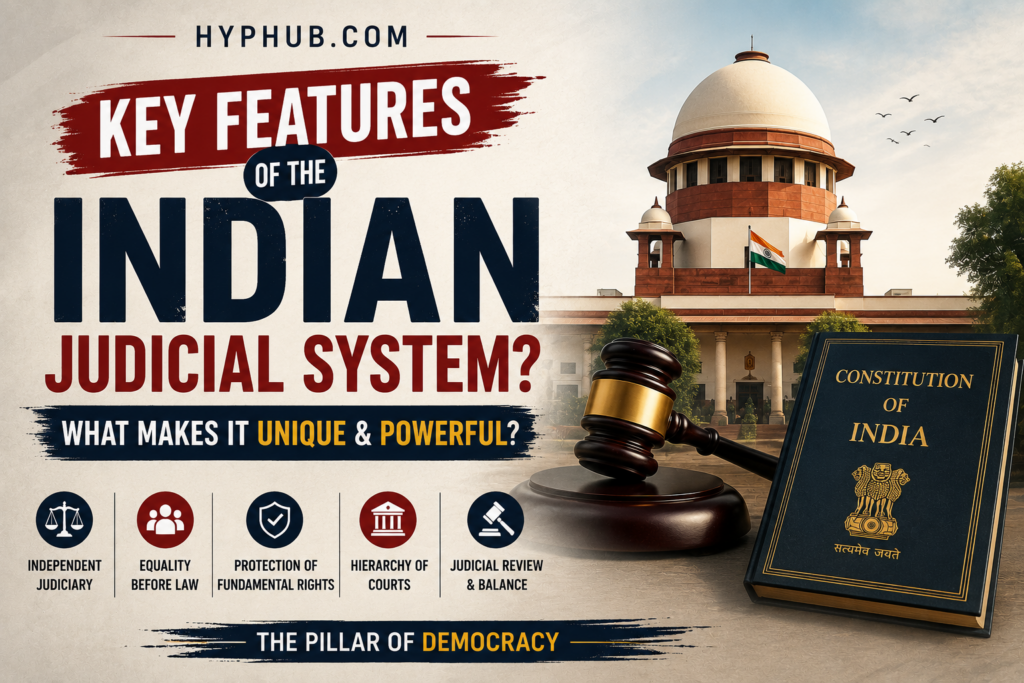
The Indian judicial system has several unique features that distinguish it from many other legal systems around the world.
- Independent Judiciary
One of the most important characteristics of the Indian Judicial System is its independence. Judges are expected to decide cases solely on the basis of the Constitution, statutes, judicial precedents, and the evidence before them.
This independence strengthens public trust in the administration of justice.
- Single Integrated Judicial System
Unlike some countries that have separate federal and state court systems, Indian Judicial System follows a single integrated judicial system.
All courts operate within one unified structure:
Supreme Court of India ↓ High Courts ↓District & Sessions Courts ↓Civil & Criminal Courts ↓Special Courts & TribunalsThis structure ensures consistency in legal interpretation across the country.
- Judicial Review
The Indian Judicial System has the power to examine whether laws passed by Parliament or State Legislatures comply with the Constitution.
If a law violates constitutional provisions, the courts can declare it unconstitutional.
This power is known as Judicial Review, and it helps maintain the supremacy of the Constitution.
- Open Court System
Most court proceedings in India are conducted openly, allowing transparency and public confidence in the justice delivery process in Indian Judicial System.
However, certain sensitive matters—such as cases involving children or sexual offences—may be heard in camera (closed proceedings) to protect privacy and dignity.
- Equal Justice for All
Every individual, irrespective of religion, caste, gender, economic background, or social status, has the right to seek justice before the courts.
This principle reflects the constitutional commitment to equality before the law.
Independence of the Indian Judicial System
The Constitution of India establishes safeguards to preserve judicial independence.
Some of these safeguards include:
- Security of tenure for judges.
- Fixed service conditions.
- Removal of judges only through a constitutional process.
- Separation of the judiciary from the executive in many judicial functions.
- Judicial decisions based on law rather than external influence.
Judicial independence is widely regarded as one of the cornerstones of constitutional democracy.
Hierarchy of Courts in Indian Judicial System
India has a well-organized court hierarchy designed to ensure that cases are heard at the appropriate level while also providing opportunities for appeal.
The Supreme Court of India stands at the top of India’s judicial hierarchy. To understand its structure, constitutional position, powers and jurisdiction in detail, read our Supreme Court of India: Structure, Powers, Jurisdiction & Role Explained.
The hierarchy is as follows:
| Level | Court | Primary Role |
| 1 | Supreme Court of India | Highest constitutional court and final court of appeal |
| 2 | High Courts | Highest courts within States and certain Union Territories |
| 3 | District & Sessions Courts | Principal courts at the district level |
| 4 | Civil & Criminal Courts | Handle local civil and criminal disputes |
| 5 | Special Courts & Tribunals | Deal with specialized legal matters |
This hierarchical structure ensures an orderly system of justice and allows higher courts to review decisions of lower courts where permitted by law.
Supreme Court of India – The Guardian of the Constitution
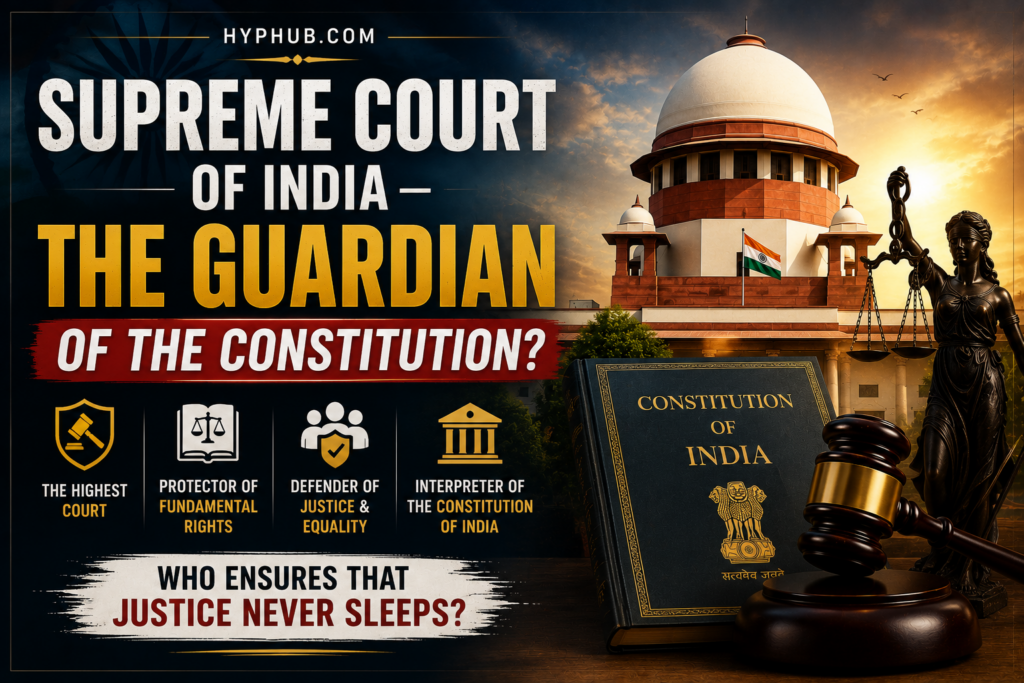
The Supreme Court of India is the highest judicial authority in the country. Established on 26 January 1950, it serves as the final interpreter of the Constitution and the ultimate court of appeal.
Situated in New Delhi, the Supreme Court plays a crucial role in protecting constitutional values and ensuring that laws are applied consistently across India.
Constitutional Basis
The Supreme Court is established under Articles 124 to 147 of the Constitution of India.
These provisions govern its composition, powers, appointment of judges, jurisdiction, and procedures.
Jurisdiction of the Supreme Court
The Supreme Court exercises different types of jurisdiction depending on the nature of the case.
Original Jurisdiction
Certain disputes can be filed directly before the Supreme Court without first approaching lower courts.
Examples include:
- Disputes between the Union Government and one or more States.
- Disputes between two or more States involving legal rights.
These matters often involve constitutional or federal issues.
Appellate Jurisdiction
The Supreme Court hears appeals against judgments delivered by High Courts in civil, criminal, and constitutional matters where the law permits such appeals.
It acts as the final judicial authority for many significant legal disputes.
Writ Jurisdiction
Under Article 32, citizens can directly approach the Supreme Court for the enforcement of their Fundamental Rights.
Dr. B. R. Ambedkar famously described Article 32 as the “heart and soul of the Constitution” because it provides an effective constitutional remedy when fundamental rights are violated.
Advisory Jurisdiction
Under Article 143, the President of India may seek the Supreme Court’s opinion on important questions of law or constitutional interpretation.
Although such opinions carry significant persuasive value, they are distinct from judgments delivered in ordinary legal disputes.
Types of Cases Heard by the Supreme Court
The Supreme Court deals with a wide variety of important legal matters, including:
- Constitutional disputes
- Fundamental Rights cases
- Public Interest Litigations (PILs)
- Civil appeals
- Criminal appeals
- Election-related constitutional issues
- Environmental matters
- Human rights issues
- Matters of national importance
Its decisions often influence public policy, constitutional governance, and the development of Indian law.
Landmark Judgment: Kesavananda Bharati v. State of Kerala (1973)
One of the most significant judgments in Indian constitutional history is Kesavananda Bharati v. State of Kerala (1973).
In this case, the Supreme Court introduced the Basic Structure Doctrine, holding that while Parliament has broad powers to amend the Constitution, it cannot alter its fundamental framework.
This judgment strengthened constitutional democracy by protecting essential principles such as judicial independence, the rule of law, separation of powers, and democracy from being removed through constitutional amendments.
Even today, this decision remains one of the most influential precedents in Indian constitutional law.
High Courts – The Highest Courts in the States
High Courts form the second level in India’s judicial hierarchy and serve as the highest judicial authority within each State or for groups of States and Union Territories.
They supervise subordinate courts within their territorial jurisdiction and ensure that justice is administered in accordance with the Constitution and the law.
High Courts play a vital role in resolving appeals, protecting legal rights, and interpreting laws at the state level.
Constitutional Basis
High Courts are established under Articles 214 to 231 of the Constitution of India.
Each High Court is headed by a Chief Justice and supported by other judges appointed in accordance with constitutional provisions.
Jurisdiction of High Courts
High Courts exercise several types of jurisdiction, including:
- Original Jurisdiction (for certain matters prescribed by law)
- Appellate Jurisdiction over District Courts and subordinate courts
- Writ Jurisdiction under Article 226
- Supervisory Jurisdiction over subordinate courts
One notable feature is that Article 226 empowers High Courts to issue writs not only for the enforcement of Fundamental Rights but also for other legal rights in appropriate cases, giving them a broader writ jurisdiction than the Supreme Court under Article 32.
Types of Cases Heard by High Courts
High Courts commonly hear the following:
- Civil appeals
- Criminal appeals
- Writ petitions
- Public Interest Litigations
- Property disputes
- Company matters
- Taxation matters
- Election petitions, where provided by law
- Constitutional questions
Conclusion (Part 1)
The Indian Judicial System is one of the strongest pillars of Indian democracy, ensuring that justice is delivered fairly, impartially, and in accordance with the Constitution. From protecting the Fundamental Rights of citizens to interpreting laws and resolving disputes, the judiciary plays an essential role in maintaining the rule of law and strengthening public confidence in the legal system.
In this first part, we explored the meaning of the Indian Judicial System, its importance, key features, the independence of the judiciary, the hierarchy of courts, and the constitutional roles of the Supreme Court and High Courts. Understanding these institutions provides a solid foundation for appreciating how justice is administered across the country.
However, the Indian judicial framework extends far beyond the Supreme Court and High Courts. At the grassroots level, several other courts and specialized forums play a crucial role in resolving civil, criminal, family, consumer, labour, and commercial disputes efficiently.
➡️ In Part 2, we will explore District Courts, Sessions Courts, Civil Courts, Criminal Courts, Family Courts, Consumer Commissions, Labour Courts, Commercial Courts, Juvenile Justice Boards, Lok Adalats, Gram Nyayalayas, and various Tribunals. We will also understand the types of cases handled by each court and how they contribute to the effective administration of justice in India.
Frequently Asked Questions (FAQs)
1. What is the Indian Judicial System?
The Indian Judicial System is a network of courts established under the Constitution of India to interpret laws, resolve disputes, and ensure justice.
2. Which is the highest court in India?
The Supreme Court of India is the highest judicial authority and the final court of appeal in the country.
3. Why is judicial independence important?
Judicial independence helps ensure that judges decide cases fairly and without influence from political or external pressures.
4. What is the main function of the Supreme Court?
The Supreme Court interprets the Constitution, protects Fundamental Rights, and hears important constitutional and appellate cases.
5. What is the role of a High Court?
A High Court supervises subordinate courts within its jurisdiction and hears civil, criminal, constitutional, and writ matters.
6. Can citizens directly approach the Supreme Court?
Yes. Under Article 32 of the Constitution, citizens may directly approach the Supreme Court for the enforcement of their Fundamental Rights.
7. How is the Indian court system organized?
India follows a single integrated judicial system with the Supreme Court at the top, followed by High Courts, District Courts, subordinate courts, and specialized tribunals.
8. What will be covered in Part 2 of this guide?
Part 2 explains the functioning of District Courts, specialized courts, tribunals, Lok Adalats, Gram Nyayalayas, and the types of cases handled by each.