
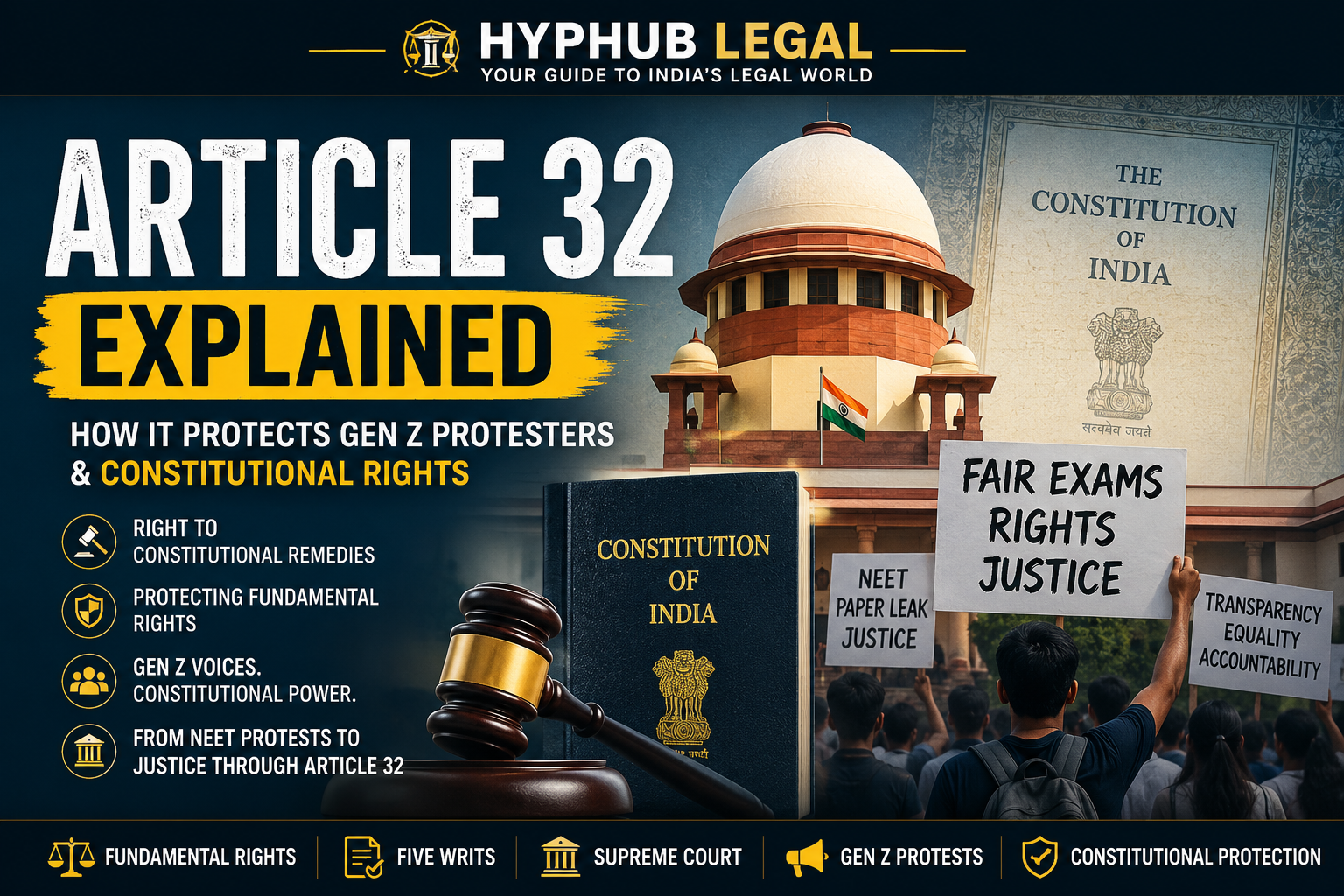
Introduction: From the NEET Paper Leak to Article 32 Explained their Constitutional Rights
Imagine spending years preparing for one of India’s toughest competitive examinations. You sacrifice weekends, avoid social gatherings, study for long hours, and dream of becoming a doctor. Then, just after the examination, news reports begin alleging that the question paper may have been leaked. Students across the country start questioning whether the examination was conducted fairly. Social media fills with hashtags demanding justice, parents express concern, coaching institutes react, and thousands of students peacefully protest while others approach the courts seeking legal remedies.
This was the reality during the NEET-UG 2024 controversy, one of the biggest student movements in recent years. For millions of young people, it was not just about an entrance examination. It became a larger debate about fairness, transparency, accountability, and equal opportunity in India’s education system.
The controversy also raised an important constitutional question:
What can citizens do when they believe their Fundamental Rights have been violated?
India’s Constitution provides a powerful answer through Article 32, a provision that empowers citizens to approach the Supreme Court of India for the enforcement of their Fundamental Rights. The Supreme Court of India plays a central role in protecting Fundamental Rights through its writ jurisdiction under Article 32. For a broader understanding of its structure, powers and jurisdiction, see our Supreme Court of India: Structure, Powers, Jurisdiction & Role Explained. This article is not limited to one issue or one generation. Whether the concern involves freedom of speech, equality before the law, personal liberty, or other Fundamental Rights, Article 32 serves as a constitutional safeguard against arbitrary actions by the State.
In an era where Generation Z (Gen Z) is actively participating in discussions on education reforms, employment, digital privacy, climate change, and social justice, understanding Article 32 has become more important than ever. While peaceful protests are a legitimate part of democracy, they are most effective when supported by knowledge of constitutional rights and legal remedies.
This article explores the meaning of Article 32, why Dr. B.R. Ambedkar described it as the “Heart and Soul of the Constitution,” how it protects citizens’ rights, and what lessons young Indians can learn from events such as the NEET-UG controversy.
What Was the NEET-UG 2024 Controversy?
The National Eligibility cum Entrance Test (NEET-UG) is India’s primary entrance examination for admission to undergraduate medical courses such as MBBS, BDS, and other allied health programmes. Every year, millions of students appear for this highly competitive examination, making it one of the most significant academic events in the country.
In 2024, however, the examination became the subject of widespread public attention due to allegations of paper leaks, irregularities in the conduct of the examination, unusually high scores by some candidates, and concerns regarding transparency. These allegations created uncertainty among students who had spent years preparing for the examination.
As concerns grew, students and parents organized peaceful demonstrations, launched online awareness campaigns, and filed petitions before the courts. Many candidates requested judicial scrutiny of the examination process and sought remedies through legal channels.
The Supreme Court eventually heard multiple petitions related to the examination. While the Court carefully examined the allegations and the evidence presented, the controversy highlighted the important role that constitutional institutions play in resolving disputes through the rule of law rather than public confrontation.
For Gen Z, the episode became a reminder that in a constitutional democracy, citizens have both the right to raise concerns and the responsibility to pursue lawful remedies.
Why the NEET Protests Became More Than an Examination Issue
Although the immediate concern related to the alleged irregularities in NEET-UG 2024, the protests reflected broader issues that resonate with many young Indians.
Students voiced concerns about:
- Fairness in competitive examinations.
- Equal opportunities for deserving candidates.
- Transparency in public recruitment and admissions.
- Accountability of examination authorities.
- Trust in national institutions.
- The need for stronger safeguards against examination malpractice.
For many students, these issues extended beyond one examination. They reflected a desire for a system in which merit, integrity, and transparency are consistently upheld.
The protests also demonstrated how social media has transformed civic participation. Platforms such as Instagram, X (formerly Twitter), Reddit, and YouTube enabled students from different parts of India to share experiences, discuss legal developments, and raise public awareness almost instantly.
Unlike previous generations that relied mainly on newspapers and television, Gen Z uses digital platforms to participate in public discourse. This shift has made young people one of the most influential voices in contemporary democratic conversations.
Why Understanding the Article 32 Explained their Constitutional Rights Matters During Public Protests
Peaceful protests are an important part of every democracy. They allow citizens to express concerns, advocate for reforms, and participate in public discussions.
However, every democratic movement eventually reaches an important stage where legal questions arise.
For example:
- Can authorities restrict a peaceful protest?
- What happens if individuals are detained unlawfully?
- Can citizens challenge unconstitutional government actions?
- What remedies are available if Fundamental Rights are violated?
These questions cannot be answered through public opinion alone. They require an understanding of the Constitution.
This is where Article 32 becomes one of the most significant provisions of Indian constitutional law.
What is Article 32 explained in the Indian Constitution?
Article 32 guarantees every citizen the Right to Constitutional Remedies.
It provides that whenever a person’s Fundamental Rights are violated by the State, they may directly approach the Supreme Court of India for appropriate relief.
Unlike many constitutional systems where rights exist without direct remedies, the Indian Constitution makes the remedy itself a Fundamental Right.
This means Article 32 is not merely a procedural provision—it is itself one of the Fundamental Rights guaranteed under Part III of the Constitution.
The Supreme Court has the authority to issue constitutional writs to enforce these rights and ensure that public authorities act within constitutional limits.
Simply put:Article 32 transforms constitutional promises into enforceable legal rights.
Without Article 32, many Fundamental Rights would be difficult to protect effectively.
Why Did Dr. B.R. Ambedkar Call Article 32 the “Heart and Soul of the Constitution”?
During the debates of the Constituent Assembly, Dr. B.R. Ambedkar emphasized that merely listing rights in the Constitution would not be sufficient.
He believed that every right must be accompanied by an effective legal remedy & Article 32 Explained.
He famously stated:
“If I was asked to name any particular Article in this Constitution as the most important—an Article without which this Constitution would be a nullity—I could not refer to any other Article except this one. It is the very soul of the Constitution and the very heart of it.”
This statement reflects one of the most important principles of constitutional law:
A right without an effective remedy has little practical value.
Article 32 ensures that citizens are not left helpless when their Fundamental Rights are violated. Instead, they can seek judicial protection from the highest court in the country.
Even today, more than seven decades after the Constitution came into force, Article 32 remains one of the strongest safeguards of democracy in India.
Why Article 32 Is More Relevant Than Ever for Gen Z
Generation Z is growing up in a rapidly changing world shaped by digital technology, social media, artificial intelligence, and instant access to information. Young Indians today are not only students but also active participants in public debates on education, employment, digital privacy, climate change, gender equality, and governance.
As civic participation increases, so does the need for constitutional awareness.
Knowing what your rights are, how those rights are protected, and where to seek legal remedies empowers citizens to engage responsibly with democratic institutions.
Article 32 reminds every Indian that the Constitution is not just a legal document for lawyers and judges—it is a living framework that protects the rights and freedoms of ordinary citizens.
Whether the issue concerns examination fairness, freedom of speech, personal liberty, or equality before the law, Article 32 ensures that constitutional rights remain enforceable through the judicial system.
How Article 32 Protects Gen Z Protesters: Constitutional Remedies Explained
As discussed in the previous section, Article 32 is known as the “Heart and Soul of the Indian Constitution” because it gives citizens the power to approach the Supreme Court of India whenever their Fundamental Rights are violated. However, this protection is not merely theoretical. The Constitution equips the Supreme Court with specific legal tools known as constitutional writs, enabling it to provide effective relief.
For today’s Generation Z, which actively participates in discussions about education reforms, employment, digital privacy, environmental protection, and social justice, understanding these constitutional remedies is essential. Article 32 Explained knowing your rights is important, but understanding how those rights can be legally enforced is equally valuable.
The Five Constitutional Writs Under Article 32 Explained
A writ is a formal order issued by a court directing a person, authority, or lower court to act—or refrain from acting—in accordance with the law. Under Article 32 Explained the Supreme Court may issue five different writs to enforce Fundamental Rights.
1. Habeas Corpus – Protection Against Illegal Detention
Meaning: “You may have the body.”
The writ of Habeas Corpus protects individuals from unlawful or arbitrary detention. If a person is arrested or detained without following legal procedures, the Supreme Court can direct the authority to produce that individual before the Court and explain the legality of the detention.
Example: Suppose a student peacefully participates in a lawful demonstration regarding examination reforms. If the student alleges that they have been detained without following the due process of law, a petition for Habeas Corpus may be filed to challenge the legality of the detention.
This writ protects one of the most fundamental democratic values—personal liberty.
2. Mandamus – Directing Public Authorities to Perform Their Duty
Meaning: “We Command.”
The writ of Mandamus is issued when a public authority fails to perform a legal duty imposed upon it.
It cannot be issued against private individuals but only against government bodies, public officials, or statutory authorities.
Example: If a statutory authority responsible for conducting public examinations fails to perform a mandatory legal obligation affecting citizens’ rights, a court may consider issuing appropriate directions where the legal requirements are satisfied.
Mandamus ensures that public authorities remain accountable to the Constitution and the law.
3. Certiorari – Correcting Legal Errors
A writ of Certiorari enables the Supreme Court to quash an order passed by a lower court, tribunal, or quasi-judicial authority if it has acted beyond its jurisdiction or violated the principles of natural justice.
Example: If a tribunal passes an order without providing affected parties an opportunity to be heard, the Supreme Court may review and set aside that order where appropriate.
This writ protects fairness in judicial and administrative decision-making.
4. Prohibition – Preventing Excess of Jurisdiction
The writ of Prohibition is preventive in nature.
It is issued to stop a lower court or tribunal from proceeding with a matter that falls outside its legal authority.
Unlike Certiorari, which corrects an order already passed, Prohibition prevents an unlawful proceeding before it is completed.
5. Quo Warranto – Questioning Public Office
Meaning: “By What Authority?”
This writ allows the Court to examine whether a person is legally entitled to hold a public office.
If an individual occupies a constitutional or statutory office without meeting the legal qualifications, the Court may require them to justify their authority.
This writ promotes transparency and accountability in public administration.
Summary of the Five Constitutional Writs
| Writ | Purpose | Simple Example |
|---|---|---|
| Habeas Corpus | Protects against illegal detention | Challenging unlawful arrest |
| Mandamus | Directs a public authority to perform its legal duty | Authority failing to discharge a statutory obligation |
| Certiorari | Quashes an unlawful order | Tribunal exceeds its powers |
| Prohibition | Prevents a court from acting beyond jurisdiction | Stopping unlawful proceedings |
| Quo Warranto | Questions the legality of a public office | Challenging an unlawful appointment |
Article 32 vs Article 226: What’s the Difference?
Many law students and competitive exam aspirants confuse Article 32 with Article 226 because both relate to constitutional remedies and empower courts to issue writs. However, they differ in scope and jurisdiction.
| Feature | Article 32 | Article 226 |
|---|---|---|
| Court | Supreme Court | High Courts |
| Purpose | Enforcement of Fundamental Rights | Enforcement of Fundamental Rights and other legal rights |
| Nature | Fundamental Right | Constitutional power of High Courts |
| Scope | Limited to Fundamental Rights | Wider scope, including other legal rights |
| Territorial Jurisdiction | Entire India | Within the territorial jurisdiction of the High Court |
Which One Should Citizens Use?
Where a person alleges that a Fundamental Right has been violated, they may approach the Supreme Court under Article 32 or, in appropriate cases, a High Court under Article 226 which is given by Article 32 Explained. High Courts are often more accessible because they are located within each State and possess broader powers to address both constitutional and legal rights.
The Rise of Gen Z Protests in India
Generation Z has emerged as one of the most politically aware and socially active generations in India’s history.
Unlike earlier generations that primarily relied on newspapers or television, Gen Z uses digital platforms such as Instagram, YouTube, Reddit, and X (formerly Twitter) to discuss public issues, share information, and organize peaceful campaigns.
Some of the issues that frequently mobilize Gen Z include:
- Examination reforms
- Employment opportunities
- Women’s safety
- Climate change
- Digital privacy
- Freedom of speech
- Internet shutdowns
- Mental health awareness
- Social equality
These discussions demonstrate an increasing awareness of constitutional values among young Indians.
The NEET-UG 2024 Case: A Turning Point for Student Activism
The NEET-UG 2024 controversy became one of the most significant examples of youth-led civic participation in recent years.
Following allegations of examination irregularities, students across India expressed concerns regarding fairness, transparency, and equal opportunity. Many believed that any compromise in the integrity of such a competitive examination could adversely affect deserving candidates who had invested years of preparation.
Students responded in several ways:
- Organizing peaceful demonstrations.
- Launching awareness campaigns on social media.
- Signing petitions.
- Participating in public discussions.
- Seeking judicial review before the Supreme Court.
The controversy highlighted an important constitutional principle: public grievances should be addressed through lawful institutions and constitutional processes.
How Article 32 Relates to Student Movements
It is important to understand that Article 32 does not automatically apply simply because citizens disagree with a government policy or examination result. Its role begins when petitioners allege that their Fundamental Rights have been violated by State action.
In the context of student movements, constitutional questions may arise regarding:
- Article 14 – Right to Equality: Allegations of arbitrary or unequal treatment.
- Article 19 – Freedom of Speech and Peaceful Assembly: The right to express opinions and participate in lawful demonstrations.
- Article 21 – Right to Life and Personal Liberty: Judicial interpretation has expanded this right to include fairness and due process in many contexts.
Whether these rights have actually been violated is determined by the courts after examining the facts and applicable law.
Comparison: Peaceful Protest vs Constitutional Remedies
| Peaceful Protest | Constitutional Remedy (Article 32) |
|---|---|
| Raises public awareness. | Seeks judicial enforcement of Fundamental Rights. |
| Expresses public opinion. | Requests legal relief from the Supreme Court. |
| May influence public policy. | May result in binding judicial directions. |
| Conducted by citizens and civil society. | Initiated through legal proceedings. |
| Encourages democratic participation. | Protects constitutional rights through the rule of law. |
Can Social Media Replace Constitutional Remedies?
The answer is no.
Social media is an effective platform for spreading awareness, educating the public, and encouraging democratic discussion. It can amplify important issues and bring national attention to public concerns.
However, constitutional disputes are ultimately resolved through legal institutions—not hashtags.
The NEET-UG controversy demonstrated this clearly. While social media played a major role in mobilizing public opinion, the final legal questions were examined by the judiciary based on constitutional principles, evidence, and the rule of law.
For Gen Z, this is perhaps the most important lesson: raising your voice is the beginning of democratic participation, but understanding the Constitution is what empowers that voice to seek lawful and lasting solutions.
Landmark Supreme Court Judgments That Shaped Article 32 Explained
Article 32 Explained through several landmark judgments of the Supreme Court. These decisions have not only protected individual rights but have also expanded the meaning and scope of Fundamental Rights in India. Each judgment demonstrates how the judiciary acts as the guardian of the Constitution.
1. Romesh Thappar v. State of Madras (1950)
This was one of the earliest constitutional cases decided after India became a republic.
The Government of Madras prohibited the circulation of a political journal on the ground of maintaining public order. Article 32 Explained The petitioner challenged the ban before the Supreme Court under, arguing that it violated the Fundamental Right to freedom of speech and expression.
The Supreme Court ruled that freedom of speech and expression is one of the essential pillars of democracy. It held that restrictions on this freedom must strictly comply with constitutional provisions.
Importance
- Strengthened Article 19(1)(a).
- Reinforced the importance of Article 32 Explained as a constitutional remedy.
- Established that arbitrary restrictions on speech could be challenged before the Supreme Court.
2. Maneka Gandhi v. Union of India (1978)
This judgment is considered one of the most transformative decisions in Indian constitutional history.
The Government impounded Maneka Gandhi’s passport without providing adequate reasons. She challenged the action, arguing that it violated her Fundamental Rights.
The Supreme Court held that Article 21 (Right to Life and Personal Liberty) must be interpreted broadly. It ruled that any law affecting personal liberty must be fair, just, and reasonable, and not arbitrary.
Importance
- Expanded the scope of Article 21.
- Connected Articles 14, 19, and 21 as interrelated Fundamental Rights.
- Strengthened constitutional protections available through Article 32 Explained.
3. Hussainara Khatoon v. State of Bihar (1979)
This case exposed the harsh reality of thousands of undertrial prisoners who had remained in jail for years without trial.
The Supreme Court held that the Right to Speedy Trial is an integral part of the Right to Life under Article 21.
Importance
- Protected the rights of undertrial prisoners.
- Expanded access to justice.
- Demonstrated how Article 32 explained safeguards for vulnerable citizens.
4. Justice K.S. Puttaswamy v. Union of India (2017)
As technology became part of everyday life, concerns regarding digital privacy also increased.
In this historic judgment, a nine-judge bench of the Supreme Court unanimously declared that the Right to Privacy is a Fundamental Right protected under Article 21.
Importance
- Recognized privacy as a constitutional right.
- Protected citizens in the digital age.
- Strengthened constitutional safeguards against unlawful intrusion.
For today’s Gen Z, this judgment is especially relevant because much of their personal, educational, and professional life exists online.
Lessons from the NEET-UG 2024 Controversy
The NEET-UG controversy highlighted that democracy is strengthened when citizens choose constitutional and lawful methods to resolve disputes.
Students did not merely express dissatisfaction; many also:
- Filed petitions before constitutional courts.
- Participated in peaceful demonstrations.
- Raised awareness through social media.
- Requested institutional reforms.
- Demanded greater transparency in examination processes.
The episode demonstrated that while public opinion plays an important role in democracy, constitutional institutions remain responsible for deciding legal disputes.
What Can Gen Z Learn from Article 32?
Today’s youth are more informed and connected than ever before. However, awareness should extend beyond social media trends to include constitutional literacy.
Understanding Article 32 Explained young citizens that:
1. Rights Are Legally Protected
The Constitution provides remedies whenever Fundamental Rights are violated.
2. Peaceful Protest Is a Democratic Tool
Citizens have the constitutional freedom to express their opinions through peaceful demonstrations, subject to reasonable restrictions imposed by law.
3. Courts Protect the Constitution
The Supreme Court acts as the guardian of Fundamental Rights and ensures that constitutional principles are upheld.
4. Knowledge Creates Responsible Citizens
Understanding constitutional law encourages informed participation rather than misinformation or emotional reactions.
5. Democracy Thrives Through Institutions
While social media raises awareness, long-term solutions often emerge through constitutional processes, judicial review, legislative reforms, and public accountability.
Rights and Responsibilities: Two Sides of the Same Coin
The Constitution grants several freedoms, but it also expects citizens to exercise those freedoms responsibly.
| Your Constitutional Rights | Your Constitutional Responsibilities |
|---|---|
| Freedom of Speech | Express opinions respectfully and lawfully. |
| Peaceful Assembly | Avoid violence and maintain public order. |
| Equality Before Law | Respect the equality and dignity of others. |
| Constitutional Remedies | Use lawful mechanisms to resolve disputes. |
| Personal Liberty | Exercise freedoms responsibly without harming others. |
A democracy remains strong only when rights are balanced with civic responsibility.
Traditional Activism vs. Gen Z Activism
Technology has significantly changed the way people participate in democratic movements.
| Traditional Activism | Gen Z Activism |
|---|---|
| Newspapers and pamphlets | Instagram, X, Reddit, YouTube |
| Local meetings | Online campaigns and nationwide discussions |
| Limited reach | Millions reached within hours |
| Physical petitions | Digital petitions and online advocacy |
| Slower information flow | Instant communication and live updates |
While the methods have evolved, the constitutional principles protecting peaceful civic participation remain unchanged.
Common Myths About Article 32
Many people misunderstand the scope of Article 32. The following table clarifies some common misconceptions.
| Myth | Reality |
|---|---|
| Article 32 applies to every legal dispute. | It is specifically designed to enforce Fundamental Rights. |
| Social media campaigns alone can deliver justice. | Courts decide constitutional disputes through legal proceedings. |
| Every protest automatically receives constitutional protection. | Peaceful protests enjoy constitutional protection, but rights remain subject to reasonable restrictions under the Constitution. |
| Only lawyers can approach the Supreme Court. | Any affected citizen may seek constitutional remedies, subject to legal procedures. |
| Article 32 guarantees success in every case. | It guarantees access to the Supreme Court, not a predetermined outcome. |
Why Every Indian Should Know About Article 32
The Constitution belongs to every citizen—not just judges, lawyers, or politicians.
Whether you are a student, teacher, entrepreneur, professional, or public servant, understanding constitutional rights empowers you to participate more effectively in democratic life.
For students, Article 32 is particularly significant because it demonstrates that legal institutions exist to protect rights and ensure accountability when constitutional questions arise.
Constitutional awareness also encourages responsible citizenship by promoting dialogue, lawful action, and respect for democratic institutions.
Conclusion :Article 32 is far more than a legal provision—it is the constitutional bridge between rights and justice. By granting citizens the Right to Constitutional Remedies, it ensures that Fundamental Rights are not merely promises written in the Constitution but enforceable guarantees protected by the Supreme Court of India.
The NEET-UG 2024 controversy illustrated how issues of education, transparency, and public trust can lead to constitutional questions. It also reminded young Indians that while peaceful protests and public discussions are important features of democracy, lasting solutions are achieved through constitutional institutions and the rule of law.
For Generation Z, Article 32 represents more than a legal remedy. It is a reminder that democracy is strongest when citizens are informed, participate responsibly, and understand both their rights and their duties. As India continues to evolve, constitutional literacy will remain essential for building a society based on justice, equality, and accountability.
In the words of Dr. B.R. Ambedkar, Article 32 remains the “Heart and Soul of the Constitution” because it ensures that every citizen has a meaningful avenue to seek justice when Fundamental Rights are at stake.
Frequently Asked Questions (FAQs)
1. Why is Article 32 called the “Heart and Soul” of the Indian Constitution?
Dr. B.R. Ambedkar described Article 32 as the “Heart and Soul” because it gives citizens a direct constitutional remedy to approach the Supreme Court whenever their Fundamental Rights are violated, making those rights meaningful and enforceable.
2. Can students approach the Supreme Court under Article 32?
Yes, if students believe that a State action has violated their Fundamental Rights, they may seek constitutional remedies under Article 32. Whether relief is granted depends on the facts of the case and the Court’s interpretation of the law.
3. How did the NEET-UG 2024 controversy highlight the importance of Article 32?
The controversy led to multiple petitions before the Supreme Court concerning alleged examination irregularities. It demonstrated how constitutional institutions provide a lawful mechanism for resolving disputes involving public importance.
4. What is the difference between Article 32 and Article 226?
Article 32 empowers the Supreme Court to enforce Fundamental Rights, while Article 226 empowers High Courts to enforce both Fundamental Rights and other legal rights, giving High Courts a broader jurisdiction.
5. What is the biggest lesson Gen Z can learn from Article 32?
The biggest lesson is that constitutional awareness empowers citizens to protect their rights through lawful and democratic means. Peaceful participation, informed advocacy, and respect for the rule of law are essential components of a healthy democracy.