
Introduction: Every country needs a rulebook, but not every rulebook is treated the way India treats its Constitution. It isn’t tucked away in a government archive gathering dust — it’s the document that decides whether a farmer can challenge a law in court, whether a journalist can criticise the government without fear, and whether a state can be forced to follow rules set by the centre. In a country as vast and diverse as India, with hundreds of languages, dozens of religions, and wildly different regional identities, the Constitution is what holds the idea of “one nation” together on paper and in practice.
Most people know the Constitution exists. Fewer know how it actually works — how it was written, what it contains, and why some of its provisions have survived unchanged for over seven decades while others have been amended more than a hundred times. This guide walks through all of that in plain language, with a comparison table to make one of its most important internal tensions easy to grasp at a glance.
What Exactly Is the Constitution of India?
At its core, the Constitution of India is the supreme legal document of the country. Every law passed by Parliament, every state legislature’s decision, and every action taken by the government must conform to it. If a law contradicts the Constitution, courts have the power to strike it down — no matter how popular that law might be politically.
It does three big jobs at once:
- It defines how the government is structured — the powers of the union, the states, and the judiciary and how they interact.
- It guarantees rights to every citizen, and in many cases, to every person within India’s borders.
- It sets out the values the country is meant to aspire to, even where those values aren’t strictly enforceable by a court.
Unlike an ordinary law, the Constitution isn’t something Parliament can casually rewrite. Changing it requires a special process, and even then, certain core features are considered untouchable — a principle that becomes important later in this guide.
A Brief History: How Constitution of India Came to Be
India’s Constitution wasn’t written overnight, and it wasn’t drafted by a handful of politicians in a closed room either. A Constituent Assembly was formed specifically for this purpose, made up of representatives elected by India’s provincial assemblies. This Assembly first met on 9 December 1946, well before India actually became independent.
Drafting a constitution for a newly independent country with immense diversity was never going to be simple. The Assembly worked for almost three years, debating structure, rights, and governance in detail. Dr B. R. Ambedkar, as Chairman of the Drafting Committee, played a central role in shaping the final text, which is part of why he’s often referred to as the chief architect of the Constitution.
The Constitution of India was finally adopted on 26 November 1949 — a date India now marks every year as Constitution Day. It came into force on 26 January 1950, which is why that date is celebrated as Republic Day. From that day forward, India transitioned from a dominion under the British Crown to a sovereign, democratic republic governed by its own supreme law.
What’s often overlooked is just how much groundwork went into this. The framers borrowed and adapted ideas from constitutions around the world — parliamentary government from Britain, fundamental rights from the United States, directive principles from Ireland, and a federal structure influenced by Canada — while weaving in provisions specific to India’s own social and historical context, such as protections against untouchability and provisions for affirmative action.
How the Constitution of India Is Structured
The Constitution of India is often described as one of the longest written constitutions in the world, and that’s not an exaggeration. It’s organised into Parts, Articles, and Schedules, each serving a distinct purpose:
- Parts group related subjects together — for example, Part III deals with Fundamental Rights, and Part IV deals with Directive Principles of State Policy.
- Articles are the individual provisions within each Part — specific rules, powers, or rights.
- Schedules are appendices that provide additional detail — such as the list of states and union territories, the allocation of seats in Parliament, or the list of recognised languages.
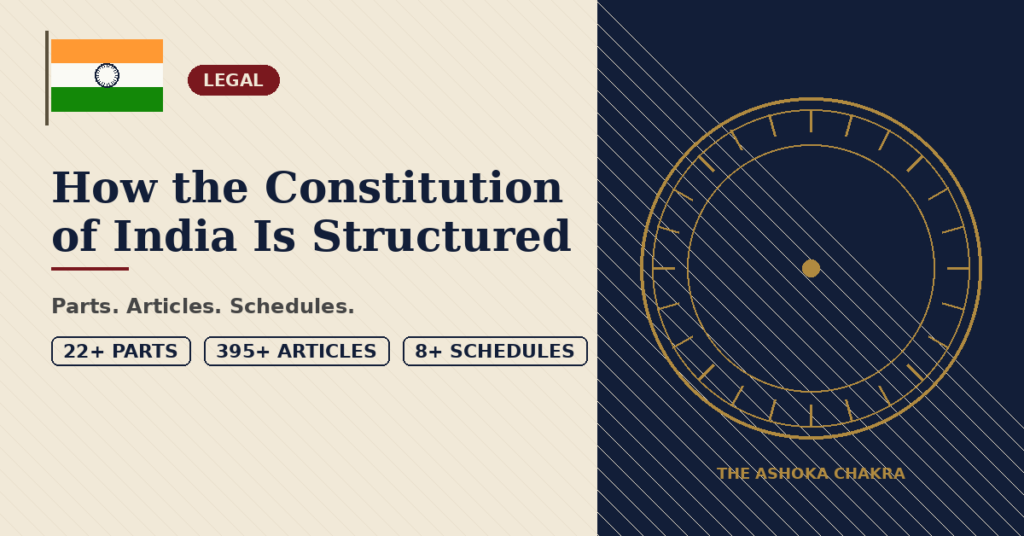
The original Constitution of India had 22 Parts, 395 Articles, and 8 Schedules. Over the decades, through amendments, the numbers have grown — additional Parts, Articles (often added as “Article 21A” style insertions), and Schedules have been introduced to address new realities, from local self-governance to environmental protections.
The Preamble: The Constitution’s Opening Statement
Before getting into rights and structure, the Constitution of India opens with a Preamble — a short introductory statement that lays out the core values the entire document is built on: justice, liberty, equality, and fraternity. It describes India as a sovereign, socialist, secular, democratic republic, committed to securing these values for all its citizens.
The words “socialist” and “secular” weren’t part of the original 1949 text—they were added later, during the Emergency period, through the 42nd Amendment in 1976. This is often cited as an example of how even foundational language in the Constitution has evolved over time, sometimes controversially.
Fundamental Rights vs Directive Principles: Two Different Kinds of Promises
One of the most important — and most misunderstood — features of the Constitution of India is the relationship between Fundamental Rights and the Directive Principles of State Policy. Both sit in the Constitution, but they work in very different ways, and understanding that difference clears up a lot of confusion about how Indian law actually functions.
Fundamental Rights, found in Part III, are legally enforceable. If the government violates one, a citizen can go directly to a High Court or the Supreme Court and demand a remedy. Directive Principles, found in Part IV, are more like a policy roadmap — they guide how the government should govern, but a citizen can’t drag the state to court simply because a directive principle hasn’t been fulfilled.
| Feature | Fundamental Rights | Directive Principles of State Policy |
|---|---|---|
| Constitutional location | Part III | Part IV |
| Enforceable in court? | Yes — directly enforceable | No — not justiciable |
| Purpose | Protect individual liberty from state overreach | Guide the state toward social and economic welfare |
| Examples | Right to Equality, Right to Freedom, Right against Exploitation | Uniform Civil Code, right to work, protection of environment |
| Nature | Largely negative — restrict what the state can do | Largely positive — direct what the state should do |
| Amendment sensitivity | Protected by the Basic Structure Doctrine | Can be expanded more freely by legislation |
Despite this difference, the two aren’t meant to work against each other. Courts have repeatedly said that Fundamental Rights and Directive Principles should be read together, each supporting the aims of the other, rather than treating one as more important than the entire document.
Fundamental Duties: The Constitution’s Third Layer
Alongside rights and principles, the Constitution of India also lists Fundamental Duties in Part IV-A, added through the 42nd Amendment in 1976. These duties ask citizens to respect the Constitution, protect public property, promote harmony, and safeguard the environment, among other responsibilities.
Like the Directive Principles, these duties aren’t enforceable in court in the same way Fundamental Rights are. They function more as a moral compass for citizens, a reminder that a functioning democracy isn’t just about what the state owes its citizens but also what citizens owe each other and the country.
Federalism: Sharing Power Between the Centre and the States
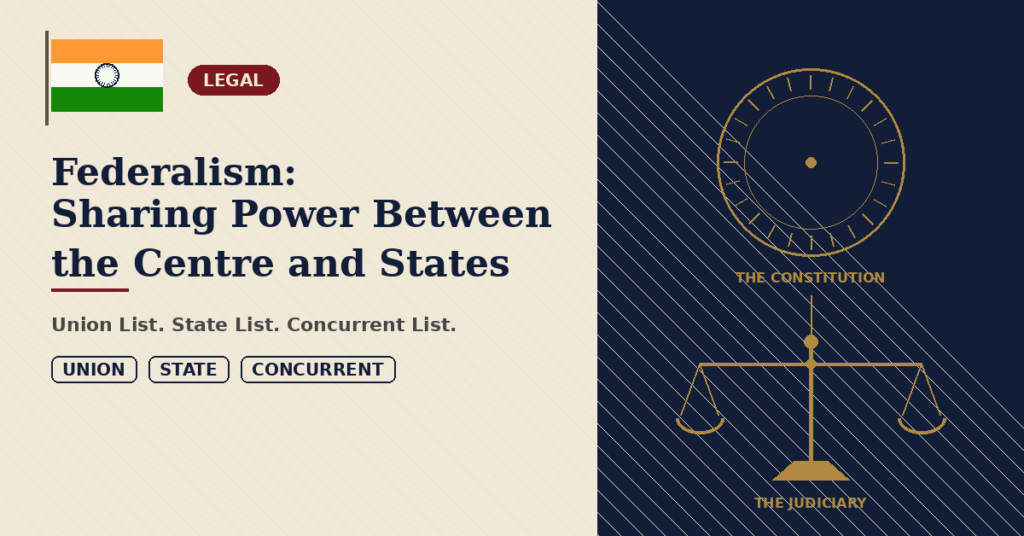
The Constitution of India creates a federal structure, meaning power is divided between the central (Union) government and individual state governments. This division is spelt out through three lists in the Seventh Schedule: the Union List (subjects only Parliament can legislate on, like defence and foreign affairs), the State List (subjects only state legislatures handle, like police and public health), and the Concurrent List (subjects both can legislate on, like education and marriage).
Unlike a purely federal system such as the United States, India’s structure leans more centralised in practice — the Union government holds stronger powers in certain situations, particularly during emergencies. This is sometimes described as “quasi-federal”, acknowledging that India blends federal principles with a strong central government.
An Independent Judiciary and the Power of Judicial Review
The Constitution of India establishes an independent judiciary, with the Supreme Court at the top, followed by High Courts and subordinate courts. This independence isn’t just a nice ideal — it’s structurally built in through how judges are appointed and protected from arbitrary removal.
One of the judiciary’s most significant powers is judicial review – the authority to examine whether a law or government action complies with the Constitution, and to strike it down if it doesn’t. This is what actually gives the Constitution teeth. Without judicial review, constitutional rights would be little more than well-written suggestions.
The Supreme Court of India acts as an important guardian of the Constitution by interpreting constitutional provisions and reviewing laws and government actions. Learn more about its structure, powers, jurisdiction and role in our detailed guide.
Amending the Constitution: Flexible, But Not Infinitely
Article 368 lays out how the Constitution of India can be amended. Unlike some countries where the founding document is treated as nearly untouchable, the Constitution of India has been amended over a hundred times since 1950 — reflecting how it was designed to evolve with the country’s needs rather than remain frozen in 1950.
That said, this flexibility has a limit. In the landmark Kesavananda Bharati case of 1973, the Supreme Court ruled that while Parliament can amend virtually any part of the Constitution of India, it cannot alter its “basic structure” – core features like democracy, secularism, judicial independence, and the rule of law. This doctrine strikes a careful balance: the Constitution of India can adapt to changing times, but its foundational identity can’t be dismantled through an amendment.
Why the Constitution of India Still Matters Today
It’s easy to think of the Constitution of India as a historical document, something finished in 1950 and left alone since. In reality, it’s actively shaping daily life in India right now — every time a court strikes down an unconstitutional law, every time a citizen exercises their right to free speech, and every time a state government challenges a central policy in court.
It’s also the reason India, despite immense diversity in language, religion, and culture, has remained a single democratic nation rather than fragmenting the way many post-colonial states have. That’s not a small achievement, and it’s largely because the framers built a document flexible enough to bend without breaking.
Conclusion: The Constitution of India isn’t just a legal formality — it’s the operating system the entire country runs on. It defines how power is shared, how rights are protected, and how disputes between citizens and the state get resolved. Its blend of enforceable rights, aspirational principles, and a carefully guarded “basic structure” is what has allowed it to survive dramatic political and social change over seven decades without losing its core identity.
Understanding how it works isn’t just useful for law students or constitutional scholars. It’s genuinely useful for any citizen who wants to understand why certain government actions get challenged in court, why some rights are absolute and others aren’t, and why India’s democracy has held together as long as it has.
Frequently Asked Questions
1. Is the Constitution of India the longest written constitution in the world?
Yes, it’s widely regarded as the longest constitution of any sovereign country. It originally had 395 Articles and 8 Schedules, and both have grown through amendments since 1950.
2. Can Parliament change any part of the Constitution of India it wants?
Parliament can amend most provisions through the process in Article 368, but it cannot alter the Constitution’s “basic structure.” This limit was established by the Supreme Court in the Kesavananda Bharati case of 1973.
3. What’s the real difference between Fundamental Rights and Directive Principles?
Fundamental Rights are legally enforceable, meaning a citizen can go to court if one is violated. Directive Principles are policy guidelines for the government and aren’t enforceable in court in the same way.
4. Why were the words “socialist” and “secular” added later to the Preamble?
They weren’t part of the original 1949 text and were inserted through the 42nd Amendment in 1976. This addition is often cited as an example of how even the Constitution’s foundational language has evolved.
5. Does the Constitution apply equally to all states in India?
Most provisions apply uniformly, but certain states and regions have special provisions tailored to their unique historical or social circumstances. These exceptions exist alongside the broader federal structure without undermining the Constitution’s overall uniformity.
Disclaimer: This article is for general informational and educational purposes only and does not constitute legal advice.