
“The Supreme Court of India is the highest court in the country and the final judicial authority under the Constitution of India. It plays a central role in protecting Fundamental Rights, interpreting the Constitution, resolving disputes and ensuring that laws and government actions comply with constitutional principles.”
In Part 1 of this series, we explored the historical development of the Indian Judicial System, its constitutional foundations, and the principles upon which it operates. We learned how the judiciary acts as an independent pillar of democracy, ensuring justice and upholding the rule of law.
This second part takes a different approach. Instead of discussing the judiciary as a whole, it begins with an in-depth study of the institution that sits at the very top of India’s judicial hierarchy—the Supreme Court. Understanding its constitutional status, composition, powers, and role is essential not only for law students but also for every citizen who wishes to understand how justice is administered in India.
The Supreme Court of India is often called the “Guardian of the Constitution.” This title is not merely symbolic. Whenever questions arise regarding constitutional interpretation, disputes between governments, violations of Fundamental Rights, or appeals involving significant legal issues, the Supreme Court acts as the final authority whose decisions shape the legal framework of the nation.
Its judgments influence governance, individual liberties, economic policies, environmental protection, gender equality, privacy rights, electoral reforms, and many other aspects of public life. Every landmark constitutional development in modern India has, in one way or another, been connected to the Supreme Court.
This article explains the Court from an educational perspective using simple language, practical examples, and constitutional principles, making it useful for students, competitive examination aspirants, legal professionals, and general readers alike.
Why Does India Need a Supreme Court?
India is the world’s largest democracy, with over a billion citizens, diverse cultures, multiple languages, different religions, and numerous State Governments operating under one Constitution. Such diversity naturally gives rise to legal disputes, constitutional questions, and conflicts between governments and citizens.
Without a single highest judicial authority, different courts across the country could interpret laws differently, leading to confusion and inconsistency. The Supreme Court of India provides uniformity by ensuring that constitutional provisions and laws are interpreted consistently throughout India.
The Court also serves as a constitutional check on the powers of the Legislature and Executive. If a law violates the Constitution or infringes upon Fundamental Rights, the Supreme Court has the authority to examine its validity and declare it unconstitutional where appropriate.
For this reason, the Supreme Court is not merely an appellate court—it is a constitutional institution entrusted with preserving the democratic values upon which the Republic of India was established.
Historical Evolution of the Supreme Court
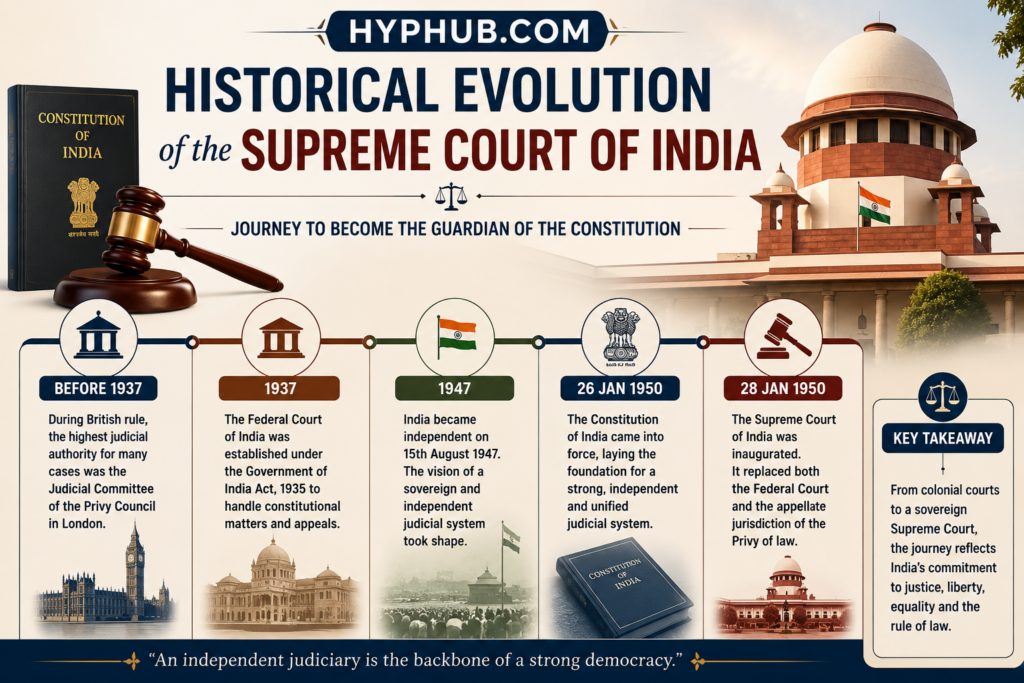
The Indian judicial system has evolved over several centuries. Before independence, the highest judicial authority for British India was the Federal Court of India, established in 1937 under the Government of India Act, 1935. While the Federal Court decided constitutional disputes and appeals, the Judicial Committee of the Privy Council in London remained the highest appellate authority for many cases.
After India became independent and adopted its Constitution on 26 January 1950, a sovereign judicial system became essential. On 28 January 1950, the Supreme Court of India was inaugurated, replacing both the Federal Court and the appellate jurisdiction of the Privy Council.
The first sitting of the Supreme Court took place in the Chamber of Princes within the Parliament House complex in New Delhi. Later, the Court shifted to its present building on Tilak Marg, where it continues to function as the nation’s highest court.
Since its establishment, the Supreme Court of India has played a central role in interpreting the Constitution, resolving constitutional disputes, and developing important legal doctrines that continue to influence Indian jurisprudence.
Constitutional Position of the Supreme Court
The Supreme Court derives its authority directly from the Constitution of India. Unlike ordinary statutory bodies created by legislation, the Supreme Court is a constitutional institution whose existence, powers, and jurisdiction are protected by the Constitution itself.
The constitutional provisions relating to the Supreme Court are primarily contained in Part V, Chapter IV of the Constitution of India, covering Articles 124 to 147.
These provisions deal with matters such as:
- Establishment of the Supreme Court
- Appointment of judges
- Qualifications of judges
- Jurisdiction and powers
- Salaries and service conditions
- Removal of judges
- Advisory jurisdiction
- Review powers
Because these powers originate from the Constitution itself, no ordinary law can abolish or fundamentally alter the Supreme Court’s constitutional status.
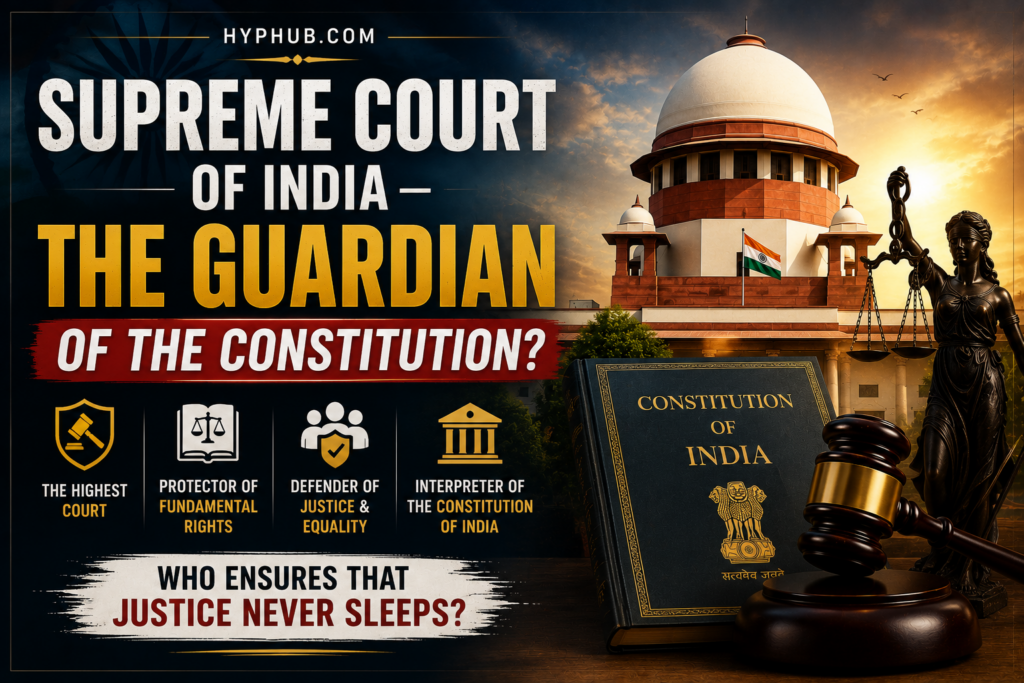
The Supreme Court as the Guardian of the Constitution
The Constitution is the supreme law of India. Every law enacted by Parliament or State Legislatures must conform to its provisions. The Supreme Court ensures that this constitutional supremacy is maintained.
Whenever questions arise regarding:
- Violation of Fundamental Rights
- Interpretation of constitutional provisions
- Legislative competence
- Distribution of powers between the Union and States
- Constitutional amendments
- Election-related constitutional disputes
The Supreme Court of India acts as the final interpreter of the Constitution.
Its decisions are binding on all courts throughout India, thereby maintaining consistency and certainty in the legal system.
Why Is the Supreme Court Called the Guardian of the Constitution?
The Supreme Court is known as the Guardian of the Constitution because it protects constitutional values against arbitrary actions by public authorities.
This responsibility includes:
- Protecting Fundamental Rights.
- Preventing misuse of governmental power.
- Interpreting constitutional provisions.
- Ensuring equality before the law.
- Maintaining the balance between the Legislature, Executive, and Judiciary.
- Preserving the federal structure of the Constitution.
Without an independent Supreme Court, constitutional guarantees could become ineffective, and citizens would have limited protection against unconstitutional actions.
Composition of the Supreme Court
The Supreme Court consists of the Chief Justice of India (CJI) and other judges whose sanctioned strength is determined by Parliament through legislation.
The Chief Justice serves as the administrative head of the Indian judiciary and is responsible for the following:
- Allocation of cases.
- Constitution of benches.
- Judicial administration.
- Supervising the functioning of the Supreme Court.
Other judges hear and decide cases individually or as part of benches depending upon the importance and constitutional nature of the matter.
Constitutional cases involving significant questions of law are generally decided by larger Constitution Benches.
Bench System in the Supreme Court
Unlike many people believe, every case is not heard by all Supreme Court judges together.
Depending upon the nature of the case, it may be heard by:
- Single Judge (where legally permitted in limited procedural matters)
- Division Bench (Two Judges)
- Three-Judge Bench
- Five-Judge Constitution Bench
- Seven-Judge Bench
- Nine-Judge Bench
- Larger Constitution Benches whenever necessary
Larger benches are constituted whenever important constitutional questions require authoritative interpretation or when earlier decisions need reconsideration.
This system promotes consistency while allowing the Court to manage thousands of cases efficiently.
Appointment of Supreme Court Judges
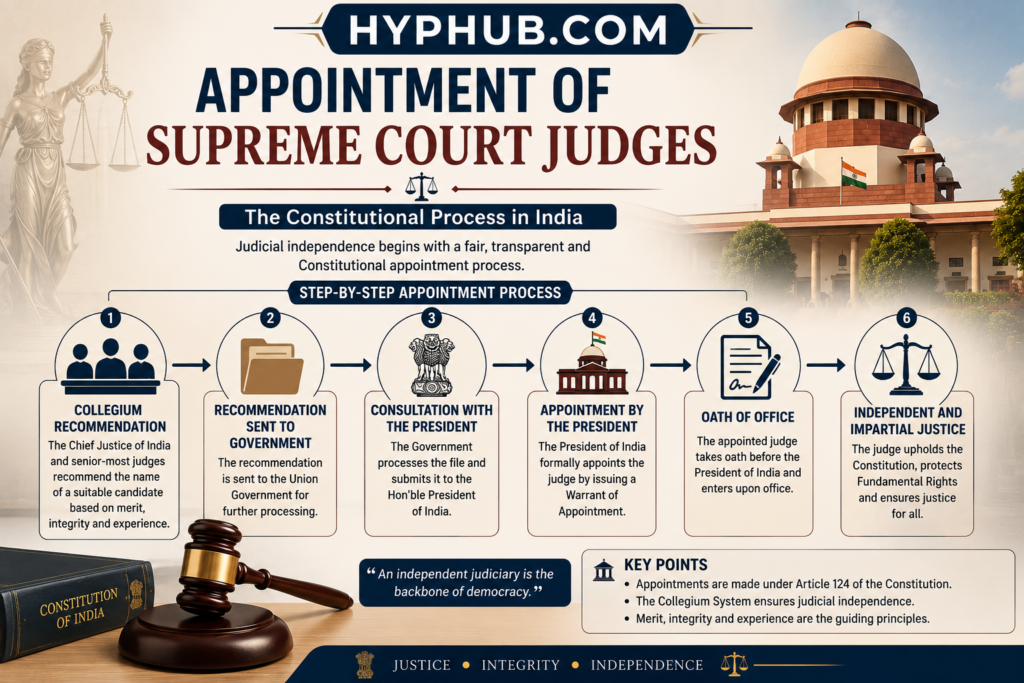
The appointment of Supreme Court judges is one of the most significant constitutional processes because judicial independence depends largely upon the manner in which judges are selected.
Under Article 124 of the Constitution, judges of the Supreme Court of India are appointed by the President of India.
Over time, through judicial decisions, the Collegium System evolved. Under this system, the Chief Justice of India and the senior-most judges recommend names for appointment and transfer of judges. The recommendations are then processed through the constitutional appointment procedure.
The objective of this process is to preserve judicial independence by minimizing external influence while ensuring that experienced and competent individuals are appointed to the nation’s highest court.
(The Collegium System and judicial appointments will be discussed in detail in Part 3 of this series.)
Qualifications of a Supreme Court Judge
A person may be appointed as a judge of the Supreme Court if they satisfy the constitutional qualifications.
Broadly, the individual must:
- Be a citizen of India.
- Have served as a judge of one or more High Courts for the required constitutional period; or
- Have practiced as an advocate in one or more High Courts for the required constitutional period; or
- Be, in the opinion of the President, a distinguished jurist.
These qualifications ensure that only individuals possessing substantial legal knowledge and professional experience are eligible for appointment.
Why Judicial Experience Matters
Judges of the Supreme Court of India decide cases involving constitutional interpretation, criminal law, civil disputes, taxation, commercial law, environmental law, election law, human rights, and numerous other complex legal fields.
Therefore, extensive legal knowledge, practical courtroom experience, impartiality, and constitutional understanding are essential qualities expected from every Supreme Court judge.
The decisions of the Supreme Court not only resolve disputes between parties but also establish legal principles that guide courts throughout India for years to come.
Key Takeaways
- The Supreme Court is the highest judicial authority in India.
- It derives its powers directly from the Constitution.
- It protects constitutional supremacy and Fundamental Rights.
- It ensures uniform interpretation of laws across India.
- Judges are appointed through the constitutional process involving the President and the Collegium System.
- The Court functions through different types of benches depending on the importance of the case.
Conclusion: The Supreme Court of India is much more than the country’s highest court. It is the constitutional conscience of the nation, entrusted with safeguarding democracy, protecting individual liberties, and ensuring that every organ of the state functions within the limits prescribed by the Constitution.
Its authority extends beyond deciding appeals; it shapes constitutional interpretation, strengthens the rule of law, and reinforces public confidence in the justice delivery system. Understanding its constitutional position, structure, and composition is the first step toward appreciating the broader functioning of the Indian judiciary.
Powers and Jurisdiction of the Supreme Court of India
The Supreme Court of India exercises several important constitutional and judicial powers to protect Fundamental Rights, interpret the Constitution, resolve disputes and ensure the proper administration of justice. Its major areas of jurisdiction include:
1. Original Jurisdiction
The Supreme Court has original jurisdiction in certain disputes, particularly disputes between the Government of India and one or more States or between different States, where the dispute involves a legal right. Article 32 also gives the Supreme Court original jurisdiction to enforce Fundamental Rights through appropriate directions, orders and writs.
2. Appellate Jurisdiction
The Supreme Court hears appeals against judgments, orders and decisions of High Courts and certain other courts and tribunals, subject to the conditions provided by the Constitution and applicable laws. It can also grant special leave to appeal under Article 136 in appropriate cases.
3. Writ Jurisdiction
Under Article 32, the Supreme Court can issue writs such as Habeas Corpus, Mandamus, Prohibition, Certiorari and Quo Warranto for the enforcement of Fundamental Rights.
4. Advisory Jurisdiction
Under Article 143, the President of India may refer certain questions of law or fact of public importance to the Supreme Court for its advisory opinion.
5. Review Jurisdiction
Under Article 137, the Supreme Court has the power to review its own judgments and orders, subject to the Constitution and the applicable rules governing review petitions.
6. Curative Jurisdiction
In exceptional circumstances, the Supreme Court may consider a curative petition after a review petition has been dismissed, but this is a very limited remedy available only on narrowly defined grounds.
7. Judicial Review
The Supreme Court can examine whether laws or government actions are consistent with the Constitution and can provide appropriate relief when constitutional requirements or Fundamental Rights are violated. Its constitutional role also includes interpreting the Constitution and ensuring that constitutional limits are respected.
In Summary
Through these powers and jurisdictions, the Supreme Court acts as the country’s highest judicial authority, protects constitutional rights, resolves important legal disputes and ensures adherence to the Constitution.
For a detailed explanation of each jurisdiction, its constitutional provisions and important landmark judgments, see our dedicated article on [Powers and Jurisdiction of the Supreme Court of India – Section 1B].
Disclaimer: This article is intended solely for educational and informational purposes. While every effort has been made to present accurate and up-to-date information based on the Constitution of India and general legal principles, this article should not be considered legal advice or a substitute for professional legal consultation. Laws, judicial interpretations, and legal procedures may change over time through constitutional amendments or court decisions. Readers are advised to refer to the latest statutory provisions and judicial pronouncements or consult a qualified legal professional for advice on specific legal matters.
Frequently Asked Questions
1. What is the Supreme Court of India?
The Supreme Court of India is the highest court in the country and the final judicial authority for interpreting and enforcing the Constitution and laws of India.
2. What are the main powers of the Supreme Court?
The Supreme Court has original, appellate, writ, advisory, review, and other constitutional powers to resolve disputes and protect constitutional rights.
3. What is the jurisdiction of the Supreme Court?
The Supreme Court has jurisdiction over constitutional matters, disputes between governments, appeals from lower courts, enforcement of Fundamental Rights, and other matters provided by law.
4. How many judges are there in the Supreme Court?
The Supreme Court can have up to 34 judges, including the Chief Justice of India, subject to the strength prescribed by Parliament.
5. What is the role of the Chief Justice of India?
The Chief Justice of India heads the Supreme Court, administers its functioning, and plays an important role in constituting benches and allocating judicial work.
6. Why is the Supreme Court called the Guardian of the Constitution?
The Supreme Court is called the Guardian of the Constitution because it can interpret constitutional provisions and invalidate laws or government actions that violate the Constitution.
7. What is the difference between the Supreme Court and High Court?
The Supreme Court is India’s highest court with nationwide authority, while each High Court primarily exercises jurisdiction over a particular state or group of states and union territories.
8. Can the Supreme Court review its own judgment?
Yes, the Supreme Court can review its own judgments under Article 137 of the Constitution, subject to the applicable legal rules and procedures.