
Introduction : What is agreement and types? In everyday life, we make promises to pay rent, to deliver services, to work for a company, or even to lend money to someone. But when these promises are written, structured, and accepted by both parties, they become something much more powerful: an agreement.
An agreement is the foundation of almost every legal and business relationship. Whether you are renting a house, starting a job, or entering into a partnership, agreements play a crucial role in protecting your rights and defining your responsibilities. So we explained clearly what is agreement and types.
In this beginner-friendly guide, we will explain what an agreement is, how and where it is used, the different types of agreements, and the legal rules in India, the UK, and the USA — all in simple language.
📖 What is an Agreement?
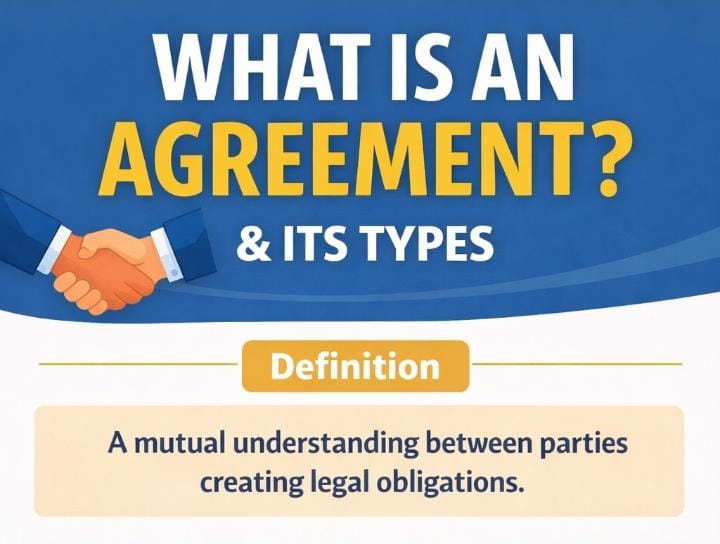
An agreement is a mutual understanding between two or more parties where each party agrees to certain terms and conditions.
In simple words:
👉 An agreement is a promise between people that is accepted by all parties involved.
For example:
- You agree to pay rent → landlord agrees to give you a house
- You agree to work → employer agrees to pay salary
An agreement becomes legally important when it includes clear terms, responsibilities, and consent from all parties.
⚙️ How Does an Agreement Work?
An agreement works on three basic elements:
1. Offer
One person makes a proposal.
Example: “I will rent you my house for ₹10,000 per month.”
2. Acceptance
The other person agrees to the offer.
Example: “I agree to pay ₹10,000 rent.”
3. Consideration
Something of value is exchanged (money, service, etc.)
Let’s talk about what is agreement and types
👉 Without these three elements, an agreement may not be valid.
📍 Where Are Agreements Used?
Agreements are used in almost every part of life. You may not always realize it, but you are surrounded by agreements every day. Lets discuss clearly what is agreement and types?
🏠 Personal Life
- Renting a house
- Buying or selling property
- Borrowing or lending money
💼 Business & Professional Use
- Service contracts
- Vendor agreements
- Freelancing work
👩💼 Employment
- Job contracts
- Salary agreements
- Company policies
👨👩👧 Family & Social Matters
- Property settlements
- Financial arrangements
👉 Whenever there is trust, money, or responsibility involved, an agreement is necessary.
📑 What is agreement and the different types of agreements?
There are many types of agreements depending on the situation. Below are the most common ones:
🏠 1. Rental Agreement
This is used between a landlord and a tenant. It includes:
- Rent amount
- Duration
- Rules for using the property
📄 2. Sale Agreement
Used when buying or selling property, goods, or assets.
💼 3. Employment Agreement
This defines:
- Salary
- Job role
- Working conditions
🤝 4. Partnership Agreement
Used when two or more people start a business together.
🔒 5. Non-Disclosure Agreement (NDA)
Used to protect confidential business information.
💰6. Loan Agreement
Used when money is borrowed or lent.
🛠️ 7. Service Agreement
Used between a service provider and a client.
👉 Each type of agreement serves a specific purpose but follows similar legal principles.
⚖️ Legal Rules of Agreements (India vs UK vs USA)
Understanding the legal side is important to know whether your agreement is valid or not.
Agreements in India
In India, agreements are governed by the Indian Contract Act, 1872.
For an agreement to be legally valid, it must include:
- Offer and acceptance
- Lawful consideration
- Free consent
- Legal purpose
👉 Not all agreements are enforceable only those meeting legal conditions become contracts.
Agreements in the UK
In the UK, agreements are based on common law principles.
Key elements include
- Offer and acceptance
- Intention to create legal relations
- Consideration
👉 Social agreements (like promises between friends) are usually not legally enforceable.
Agreements in the USA
In the USA, contract laws vary by state but follow similar principles:
- Mutual agreement
- Consideration
- Legal capacity
- Lawful purpose
👉 Written agreements are strongly preferred for legal protection.
📊 Key Differences (India vs UK vs USA)
| Feature | India | UK | USA |
| Main Law | Indian Contract Act | Common Law | State Laws |
| Written Agreement | Recommended | Recommended | Recommended |
| Verbal Agreement | Valid (hard to prove) | Recommended | Valid (limited) |
| Legal Enforcement | Based on contract law | Based on intent | State-based enforcement |
⚠️ Risks and “Side Effects” of Agreements
Many people sign agreements without fully understanding them. This can lead to serious problems.
Common Risks:
- Hidden clauses
- Unfair terms
- Financial loss
- Legal disputes
- Difficulty in cancellation
Real-Life Example of what is agreement and types
A tenant signs a rental agreement without reading the notice clause later, they are forced to vacate within 7 days.
👉 Lesson: Always read before signing any agreement.
🛑 Common Mistakes to Avoid
- Not reading the full document
- Ignoring legal terms
- Not checking duration and conditions
- Signing without witness (in important cases)
- Not keeping a copy
❓ Frequently Asked Questions (FAQs)
1. Is every agreement legally binding?
No, only agreements that meet legal conditions are enforceable.
2. Can an agreement be verbal?
Yes, but written agreements are always safer.
3. What happens if someone breaks an agreement?
It can lead to legal action or compensation.
4. Is registration required for agreements in India?
Some agreements (like property- related) require registration.
5. Why are written agreements important?
They provide proof and prevent disputes.
🏁 Conclusion
An agreement is one of the most important legal tools in everyday life. Whether you are in India, the UK, or the USA, agreements help define responsibilities, protect rights, and prevent misunderstandings.
For beginners, the most important thing is simple:
👉 Understand what you are signing before you sign it.
A well-written agreement can save you from legal trouble, financial loss, and unnecessary stress.